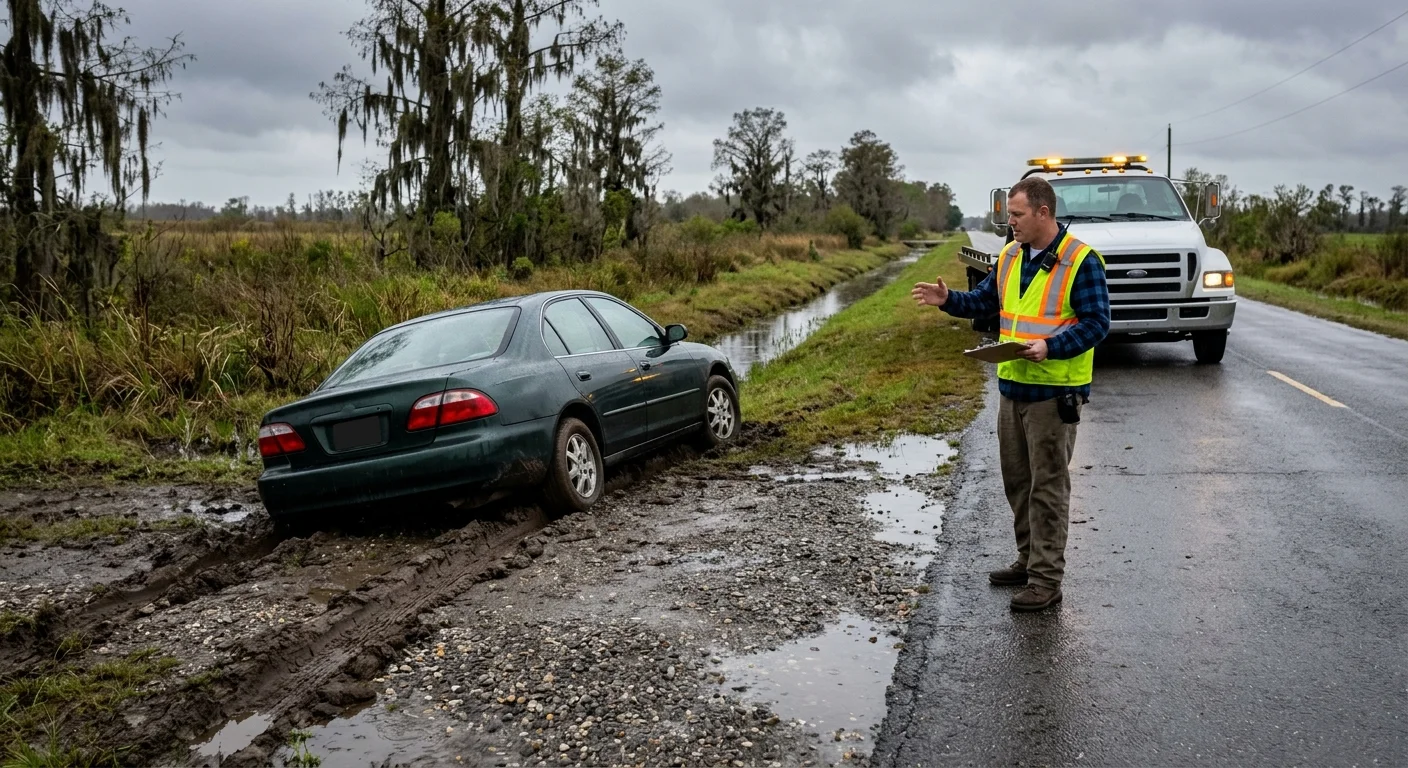
Lead with surface, standing water, and whether all wheels roll. See winch-out and when your car floods. We do not invent parish mud-fee tables.
Start with where the car is stuck
Location determines what kind of recovery is practical. A sedan beside firm pavement presents a different job than one deep inside a soft lot.
Tell us whether the car is on a shoulder, driveway, field, ditch edge, or gravel parking area. Mention the nearest firm surface and how far the vehicle sits from it. An operator also needs to know whether another vehicle blocks access.
Metro New Orleans covers several distinct road networks. A muddy shoulder in Orleans Parish isn’t the same as a soft lot in Metairie. A ditch edge in St. Bernard Parish may offer different access than an unpaved site on the North Shore. West Bank locations can also require a different approach from sites near I-10 or I-610.
Describe the ground around the car, not only the buried tires. Firm pavement behind the vehicle may allow a straightforward winch-out. Soft ground on every side can change the equipment and vehicle placement needed. Limited overhead clearance, a narrow gate, or a sharp entrance also matters.
Standing or rushing water changes the situation. Never drive or walk into floodwater. If water reached the vehicle, follow the steps in our New Orleans flooded-car guide. That problem may involve more than mud around the tires.
A clear location description helps us match you with an operator suited for accident recovery and winch-outs. It also reduces the chance that important access details get missed.
Wheel position and vehicle condition change the recovery
A winch-out works best when the main problem is lost traction. The operator pulls the vehicle onto stable ground, then checks whether it can leave under its own power.
Report how deeply each wheel is buried. One tire resting in a shallow rut is different from an axle or underbody sitting on the ground. Note whether the car is level, leaning toward a ditch, or resting at an angle.
Wheel position matters too. Tell the operator whether the front wheels are straight or turned. Report any tire that looks flat, separated from its rim, or pressed against the body. Don’t try to reposition anything underneath the vehicle.
Describe what happened before the car stopped moving. The operator should know whether the wheels spun, the vehicle slid sideways, or the front or rear settled first. These details help show how the car entered the mud and where resistance may be concentrated.
Vehicle condition can turn a pull-out into a transport job. Mention visible body damage, leaking fluid, warning lights, unusual noises, or steering that no longer responds normally. Also report whether the engine runs and the transmission selects a gear.
Share the vehicle type and drive system if you know them. A low sedan, pickup, van, electric vehicle, or loaded work truck may need a different recovery plan. If you don’t know the drive system, give the year, make, and model instead.
A pull-out and a transport tow solve different problems
A pull-out moves a stuck vehicle back onto stable ground. A transport tow carries a vehicle that shouldn’t continue driving. Some calls need one service, while others need both.
A basic winch-out may be enough when the car is undamaged and can roll, steer, and brake after recovery. The matched operator makes that decision after seeing the vehicle and the ground around it.
Transport becomes more likely when the car can’t move normally after reaching firm ground. Examples include a damaged wheel, steering problem, exposed underbody damage, or a mechanical failure that happened before the vehicle entered the mud. The destination also matters. A car headed to a repair shop needs transport even after it is free.
Explain the full problem when you call. Saying “stuck in mud” can sound like a pull-only request. Add whether the vehicle starts, rolls, steers, and has visible damage. Tell us if you already expect it to go to a home, shop, or another permitted location.
Mud recovery also differs from ordinary roadside assistance. A jump-start or tire change addresses a disabled vehicle on stable ground. A buried vehicle needs recovery access before another roadside problem can be handled.
The operator controls the recovery setup. Quick Tow New Orleans doesn’t own trucks or perform the pull. We match callers with independent, licensed local operators based on the facts provided.
Wet shoulders and soft lots need accurate location details
Rain can make a firm-looking shoulder difficult to access. Give the operator a clear picture of where pavement ends and soft ground begins. Photos taken from firm ground can help document tire depth, vehicle angle, and nearby access.
Use a dropped map pin when the street address doesn’t identify the vehicle. Add the road name, direction of travel, nearest exit, cross street, or recognizable entrance. On divided roads, the correct side matters because the opposite shoulder may not provide access.
For locations near I-10, I-610, or US-90B, check 511 Louisiana for current incidents, closures, construction, and weather conditions. A driver stopped on those corridors can also review our guide for a breakdown on I-10 or the Causeway.
The DOTD Motorist Assistance Patrol is a fixed-schedule patrol, not a call-out towing service. It can move disabled vehicles from travel lanes and provide limited roadside help. It doesn’t transport a vehicle away for repair.
If the vehicle is in an active travel lane, contact local law enforcement. If it is completely outside traffic, explain how much firm shoulder remains around it. Don’t describe the location as “near New Orleans” when a parish, exit, or map pin is available.
Private lots need the same precision. Name the business entrance, gate, building side, or row where the car sits. Mention locked gates or access rules before an operator is matched.
What to report before an operator is matched
Start with the exact location. Give the address or map pin, parish, nearest cross street, and direction of travel. Then explain whether the operator can remain on firm pavement while assessing the vehicle.
Describe the ground in plain terms. Say whether it is wet grass, deep mud, loose gravel, a soft shoulder, or the edge of a ditch. Mention standing water separately. Report any curb, fence, narrow gate, low branch, or parked vehicle limiting access.
Next, describe the vehicle:
- Year, make, and model
- Sedan, SUV, pickup, van, motorcycle, or larger vehicle
- Which wheels are buried
- Whether the axle or underbody touches the ground
- Whether the car is level, leaning, or angled toward a ditch
- Whether it starts, rolls, steers, and brakes
- Any visible damage, leaking fluid, or flat tire
- Whether it needs transport after recovery
Photos should show the whole vehicle and its surroundings. A close image of one muddy tire doesn’t show access from the road. Include wider views from the front, rear, and firmest nearby surface when those views are available without entering floodwater.
Tell us what happened just before the vehicle became stuck. A slow roll into soft ground differs from sliding off a shoulder. Don’t guess about damage you can’t see. Say what you observed and what remains unknown.
Quick Tow New Orleans takes calls 24/7. We use these details to match you with an independent, licensed local operator. You contract with and pay that operator directly.
When to call us
Call when the car is buried, leaning, damaged, or unable to drive after reaching firm ground. Call (504) 474-5530. We match you with a licensed local operator who quotes before the truck rolls.