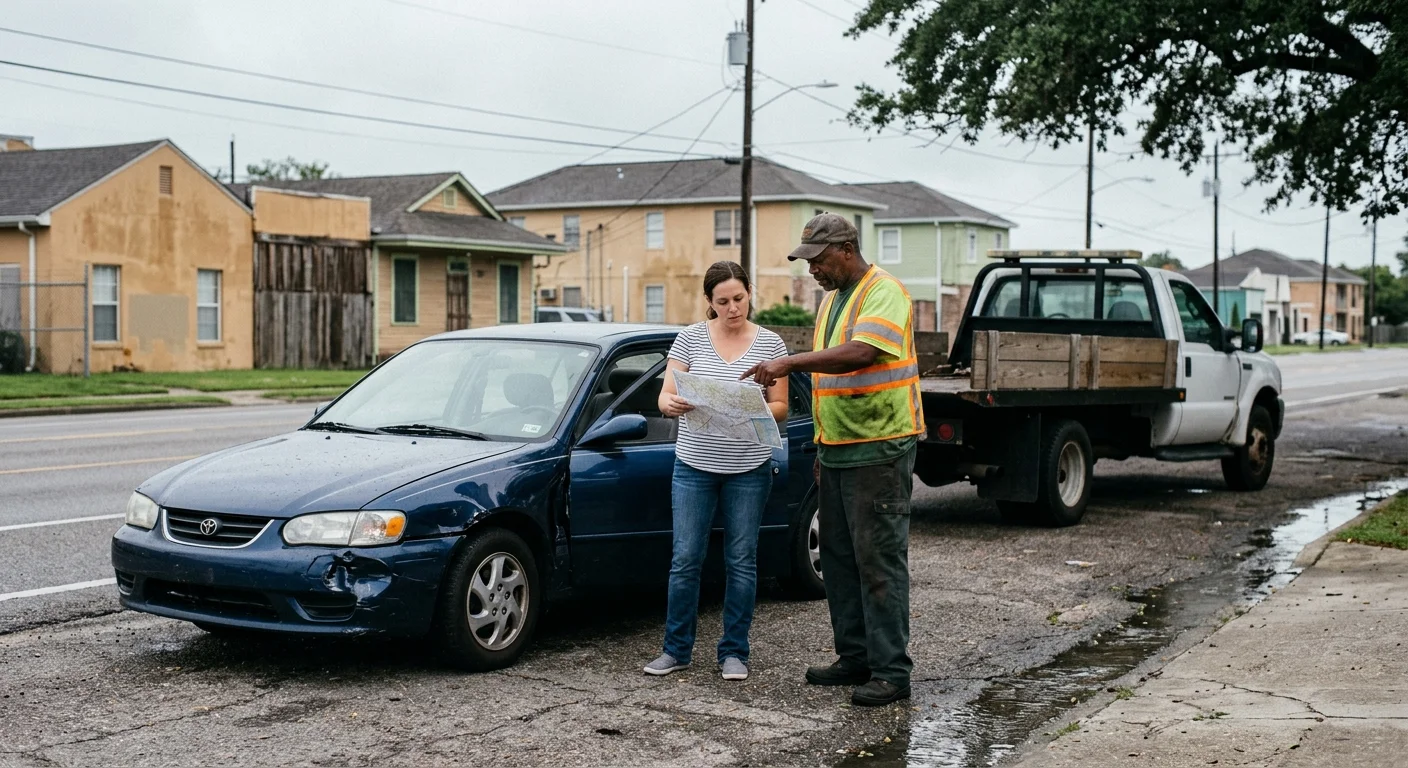
On a consensual tow you called yourself, you choose the destination. A police-arranged tow follows that agency’s destination rules. We do not invent an NOPD shop list. Recovery versus a standard load is in accident recovery or standard tow.
Start with who arranged the tow
For accident recovery towing in New Orleans, LA, destination planning starts with the call source. A driver-requested tow and an agency-arranged tow don’t begin under the same circumstances.
When you’re arranging the tow yourself, give the operator a complete destination. That might be a repair shop, your home, or an agreed storage location. A request isn’t final confirmation. The operator must accept the trip, and the receiving location must be ready for the vehicle.
Start with the exact business name and street address. Confirm where the vehicle should be placed and who will receive the keys. If it’s going to a repair shop, contact that shop before the car moves. A map listing doesn’t confirm that the business can accept a damaged vehicle.
Our accident recovery and winch-out service matches drivers with licensed, independent local operators. Quick Tow doesn’t own tow trucks, perform the recovery, or control another party’s storage facility. The matched operator performs the work.
A tow arranged by police or another public agency needs a different conversation. Ask which agency ordered it and whether a destination has already been authorized. If you want another location, ask who must approve that change before the vehicle moves.
If the destination becomes unclear after a City tow, use New Orleans’ official Find My Towed Vehicle page. Don’t guess based on the tow truck’s direction or a secondhand address.
A requested tow and an agency-ordered tow can differ
Louisiana’s towing framework draws an important line between consensual and non-consensual towing. The distinction isn’t always as obvious as it sounds.
Under the current Louisiana Public Service Commission schedule, even a tow requested by a vehicle owner through a police officer counts as non-consensual. That classification places the tow under the LPSC’s prescribed rate rules. It doesn’t, by itself, answer where the vehicle must go.
The approved Louisiana sources don’t establish one blanket destination rule for every crash. They don’t confirm that every driver may always choose any repair shop. They also don’t establish that every agency controls every destination. The specific ordering authority and circumstances matter.
When you contact an operator directly, begin by naming your requested destination. Confirm that the operator accepts it before hookup. When an officer or agency arranged the tow, ask these questions at the scene:
- Has a destination already been assigned?
- Can the vehicle go directly to my selected repair shop?
- Who must approve a destination change?
- Where will the vehicle be stored if my shop can’t accept it?
- Which operator is taking custody of the vehicle?
Quick Tow can’t override an officer, a public agency, or the matched operator. We can help connect you with a licensed operator when you need a separate requested tow. Our guide to New Orleans towing rights explains the confirmed protections for non-consensual and public-agency towing.
Choose between a repair shop, storage yard and home
Each destination solves a different problem. Choose based on what happens after the vehicle is unloaded.
A repair shop makes sense when you’ve selected the business and it has agreed to receive the car. Confirm the exact entrance, key instructions, and placement location. Ask whether someone needs to be present. A damaged vehicle shouldn’t arrive based only on an online address or an insurer’s old listing.
A storage yard can provide a holding location while repairs or insurance decisions remain unsettled. Before agreeing, ask the operator who owns the facility, where it is, and when vehicles can be accessed. Ask about current storage terms, release procedures, accepted payment methods, and personal-property access. Quick Tow doesn’t set or collect an independent operator’s charges.
Don’t confuse a private storage yard with a City of New Orleans impound facility. City fees belong to the City. LPSC maximums apply to qualifying non-consensual towing. Neither figure represents Quick Tow’s price for a driver-requested tow.
Your home may work when there’s a lawful, accessible place for unloading. Confirm that the property owner allows the vehicle there. Tell the operator about gates, narrow access, soft ground, steep approaches, or low overhead clearance. The operator must decide whether the requested placement can be completed safely.
Insurance shouldn’t be treated as automatic approval. Louisiana requires liability coverage, but it doesn’t require towing or roadside coverage. Your own policy controls whether a tow bill is covered. Review how Louisiana insurance may cover towing and contact your insurer about destination or authorization terms.
Parish lines can affect the practical destination
Metro New Orleans crosses several jurisdictions and distinct road networks. A crash in Orleans Parish isn’t the same trip as one in Jefferson Parish, St. Bernard Parish, or the North Shore.
A driver on I-10 may be choosing between shops in New Orleans, Metairie, or Kenner. A crash near US-90B can make a West Bank destination in Gretna, Harvey, or Terrytown more practical. A vehicle on the Lake Pontchartrain Causeway involves Causeway Police and a possible destination on either shore.
Crossing a parish line doesn’t automatically prove that you can or can’t select that destination. No approved source confirms such a blanket rule. Ask the ordering agency and operator before the car moves.
The parish also helps identify who arranged the tow. An Orleans Parish crash may involve a different public authority than one in unincorporated Jefferson Parish. That difference can affect whom you must contact about an agency-ordered vehicle. Write down the agency name instead of assuming every metro tow follows New Orleans City procedures.
Route conditions matter too. I-10, I-610, US-90B, and the Causeway can be affected by crashes, closures, weather, and traffic controls. Check 511 Louisiana for current incident and closure information while selecting a reachable destination.
Don’t make the decision from an active travel lane. Move to a safe location when directed, then settle the destination with the officer and operator. If you need a driver-requested tow after the immediate scene is cleared, our emergency towing service can connect you with an independent local operator.
What to confirm before the vehicle leaves
Repeat the destination aloud before hookup. Give the operator the complete street address, not just a shop name. Businesses with similar names or multiple locations can cause an avoidable second move.
Confirm these details:
- Who arranged the tow, you or a public agency
- The operator’s business name and contact information
- The exact destination and receiving entrance
- Whether the destination has agreed to accept the vehicle
- Who will take the keys
- Where the vehicle will be placed
- Whether storage is involved
- Who must approve any later destination change
Tell the operator about visible damage. Mention locked wheels, damaged suspension, loose body panels, leaking fluids, deployed airbags, or a vehicle resting off pavement. Don’t attempt a recovery that needs towing equipment and training.
When it’s safe, photograph the vehicle before it moves. Capture each side, the damaged areas, and the surrounding location. Keep any paperwork provided by the officer, operator, repair shop, or insurer.
For a non-consensual tow, request an itemized invoice. The LPSC requires the invoice to separate towing, recovery, storage, fuel surcharge, and additional charges. You don’t have to pay first merely to receive a copy of that invoice.
If the destination changes during the conversation, start the confirmation again. State the new address and ask the operator to repeat it. Confirm whether the receiving location accepted the change. Don’t assume a text sent to an insurer, relative, or repair shop also reached the operator.
Quick Tow can pass your requested destination to a matched operator. The independent operator still confirms the job and performs the tow. A public authority may also have instructions that Quick Tow can’t change.
When to call us
Call when your damaged car needs accident recovery or transport by a licensed towing pro. The line takes calls 24/7. Call (504) 474-5530. We match you with a licensed local operator who quotes before the truck rolls.