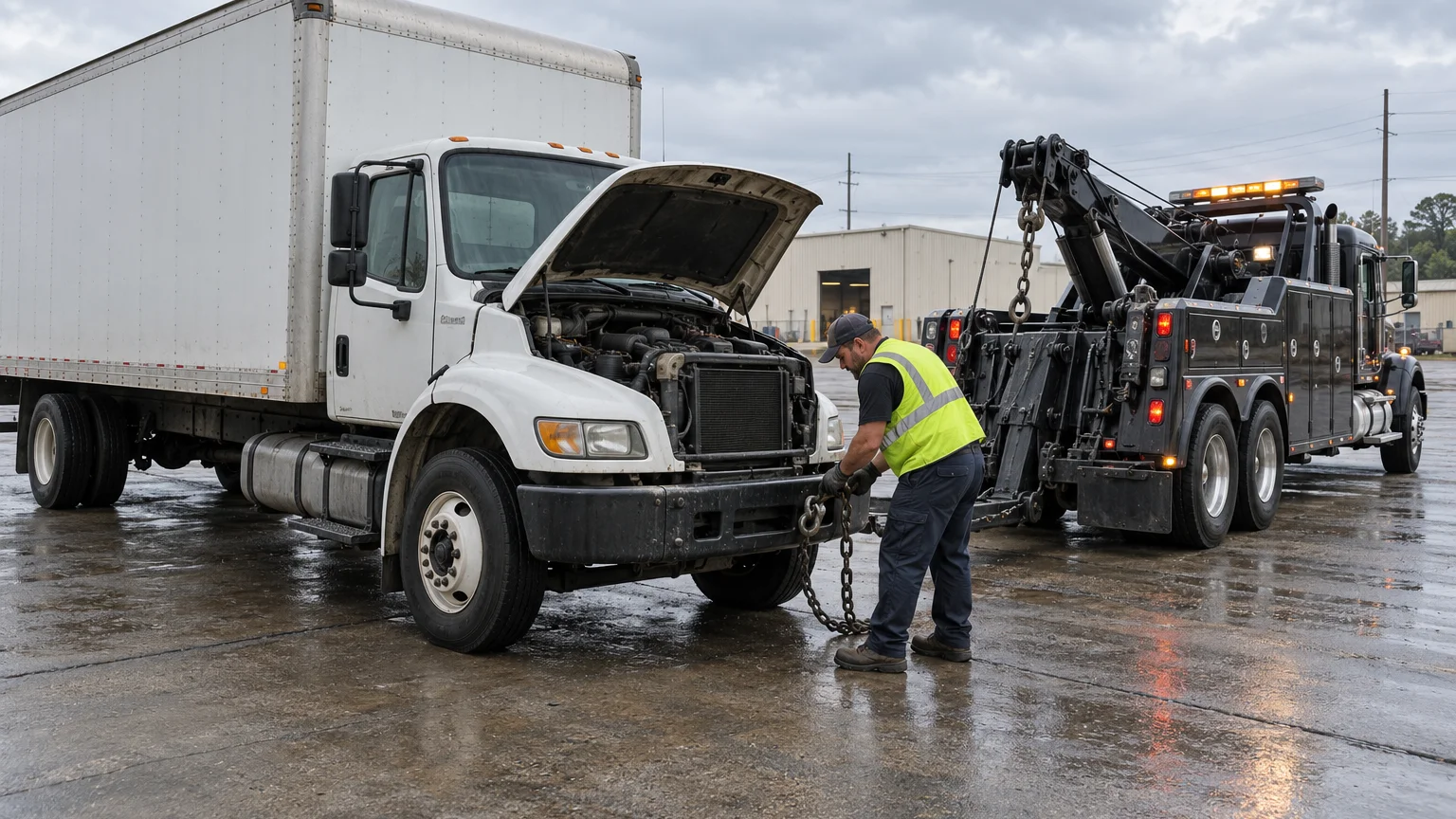
A disabled box truck in Elmwood needs a more detailed service request than a passenger car. For box truck towing in Elmwood, LA, report the exact location, truck specifications, cargo, wheel condition, site access, and planned destination.
Quick Tow New Orleans matches callers with independent, licensed local operators. Giving clear information helps the operator determine what equipment the job may require.
Start with the truck’s exact location
“Elmwood” alone doesn’t narrow the pickup point enough. Start with the street address, business name, or nearest marked entrance. Then describe where the truck sits on the property.
A breakdown near Elmwood Park Boulevard isn’t the same as one along Clearview Parkway. A truck behind a building may require different access than one near the customer entrance. If you’re near Jefferson Highway, say which side of the corridor you’re on and what entrance reaches the truck.
Share a map pin when possible. Street addresses can lead to the front door while the truck sits behind a loading area. A pin helps identify the actual stopping point. Add the nearest unit number, driveway, gate, or recognizable building feature.
Tell the operator whether the truck is:
- In a travel lane
- On a shoulder
- Inside a paved lot
- At a loading area
- Behind a closed gate
- Near a low overhead structure
- Blocking another vehicle or driveway
Don’t move around the truck to collect details if traffic makes that unsafe. Report what you can see from a protected position. For current road incidents and closures, check Louisiana’s official 511 traveler information service.
Also explain how the truck faces. A box truck pointing into a confined space presents a different setup from one facing an open drive. Mention whether another vehicle can approach its front, rear, and sides.
Drivers dealing with a broader New Orleans route can also use our New Orleans box truck breakdown guide. This Elmwood request should still begin with the precise pickup point.
Industrial drives and parking lots need clear access details
Elmwood’s commercial setting makes access information especially useful. A street address doesn’t show whether the operator can enter, turn, stage, or leave near the disabled truck.
Describe the route from the property entrance to the vehicle. Note gates, tight turns, parked trailers, loading activity, raised curbs, soft ground, or overhead obstructions. Don’t guess a clearance measurement. Report a posted number only when you can read it accurately.
If access is controlled, identify who can open the gate. That may be a property manager, tenant, security contact, or delivery receiver. Don’t promise that the towing operator can enter without permission. Confirm access with the person responsible for the property.
A useful access report might say:
The truck is behind the building, entered from the second driveway. It faces a loading area, and parked vehicles narrow the exit.
That description gives more value than saying the truck is “in the back.” Photos can also help. Take wide views of the truck, approach path, corners, overhead space, and exit. Avoid photographing private documents or unrelated people.
If the truck left the pavement, tilted, struck an object, or became pinned against something, say that before the operator is selected. The request may involve accident recovery or a winch-out instead of a straightforward tow.
Elmwood also sits close to Harahan, Metairie, and Jefferson Highway. Those names help orient the request, but they don’t replace an address or map pin. Give both the local reference and the exact stopping point.
Don’t direct traffic, crawl beneath the truck, or attempt a recovery with another vehicle. Keep the area clear and let the matched operator assess the setup.
Use the vehicle data plate for specifications
A box truck’s appearance doesn’t confirm its weight class or towing needs. Similar bodies can sit on different chassis. Use the vehicle data plate and operating documents instead of estimating.
Photograph the data plate clearly. It may be on the driver-side door area, door frame, or another manufacturer-selected location. If you can’t find it without entering an unsafe area, don’t keep searching. Tell the operator which details remain unknown.
Report the information exactly as shown, including:
- Year, make, and model
- Vehicle identification number
- Gross vehicle weight rating
- Chassis or cab configuration
- Body length, if documented
- Overall height, if documented
- Plate number and issuing state
Don’t substitute the current cargo weight for the vehicle’s rating. Don’t estimate height by comparing the box with a nearby building. If the truck’s documents list dimensions, read those figures directly.
Louisiana separates non-consensual towing into weight classes. Light Duty covers 10,000 pounds or less, Medium Duty covers 10,001 through 26,000 pounds, and Heavy Duty begins at 26,001 pounds. Those classifications come from the Louisiana Public Service Commission schedule. They shouldn’t be used to guess a particular truck’s rating.
A customer-requested tow is different from a non-consensual tow. The LPSC figures in that schedule are maximums for non-consensual service, not Quick Tow prices or customer quotes.
Our heavy-duty towing service page explains the matching service for larger commercial vehicles. The matched operator still needs the truck’s actual specifications before deciding whether the job fits its equipment.
Cargo and wheel condition can change the request
Tell the operator whether the box is empty, partly loaded, or loaded. Describe the cargo in plain terms, but don’t guess its total weight. Use a bill of lading, scale record, shipping document, or other operating record when available.
Mention anything that affects how the load sits. Cargo may have shifted after a hard stop, collision, curb strike, or tilt. Don’t open a damaged box or climb inside to inspect unstable freight. Report visible damage and let the appropriate professionals assess it.
The operator also needs the truck’s mechanical condition. State whether the engine starts, the transmission selects neutral, the steering moves, and the parking brake releases. If you don’t know, say so.
Walk around the truck only when the location is safe. Report:
- Flat, missing, or damaged tires
- Wheels turned against a curb
- A wheel that won’t rotate
- Visible axle or suspension damage
- Fluid beneath the truck
- Loose body panels
- A damaged liftgate
- Deployed airbags
- Collision damage near a wheel
Never crawl beneath the chassis to investigate. A photograph from a safe standing position is enough.
Cargo type can also affect the request. Tell the operator about refrigerated goods, machinery, loose materials, liquids, or anything identified as regulated on the shipping documents. Don’t decide how cargo must be handled yourself. The operator may need more information before accepting the job.
A simple mechanical shutdown differs from a truck that struck a barrier or left the pavement. State the event plainly. If the truck was in a crash, identify visible damage without diagnosing it.
Drivers working west of Elmwood may find different access conditions and destination choices. Our Norco box truck breakdown guide covers that separate corridor.
Choose an East Bank destination before movement
Decide where the box truck should go before movement begins. The operator needs a destination that can receive the vehicle, not just a general request to leave Elmwood.
Possible destinations include the fleet’s own lot, a repair facility, a tire shop, a body shop, or another approved commercial property. Confirm that the destination accepts the truck’s size and condition. Also confirm that someone can provide access when the vehicle arrives.
For an Elmwood breakdown, an East Bank destination may be in Elmwood, Harahan, Metairie, or another approved location. The closest place on a map isn’t automatically the right one. A passenger-car repair shop may not accept a box truck. A closed commercial lot may not allow an unattended drop.
Before calling, gather:
- The destination’s full address
- The business or property name
- A receiving contact
- Drop-off instructions
- Gate or entrance details
- Any documented vehicle-height restriction
Don’t invent instructions when the receiving location hasn’t confirmed them. If the destination is undecided, say that at the start. The matched operator can then understand that the route remains open, but the customer must still authorize the final destination.
Separate the disabled truck from its cargo plan. A repair facility may accept the vehicle without receiving or unloading its freight. Ask the cargo owner, fleet manager, or receiving business what should happen to the load.
Good destination planning prevents confusion between Elmwood’s industrial drives and nearby East Bank communities. It also gives the operator a complete pickup and delivery request before the truck moves.
When to call us
Call when a disabled box truck needs a licensed towing pro and you’ve gathered the location, vehicle specifications, condition, cargo details, access notes, and destination. The line takes calls 24/7, and Quick Tow New Orleans matches drivers with independent local operators.
Call us at (504) 474-5530 and we’ll connect you with a licensed local operator.