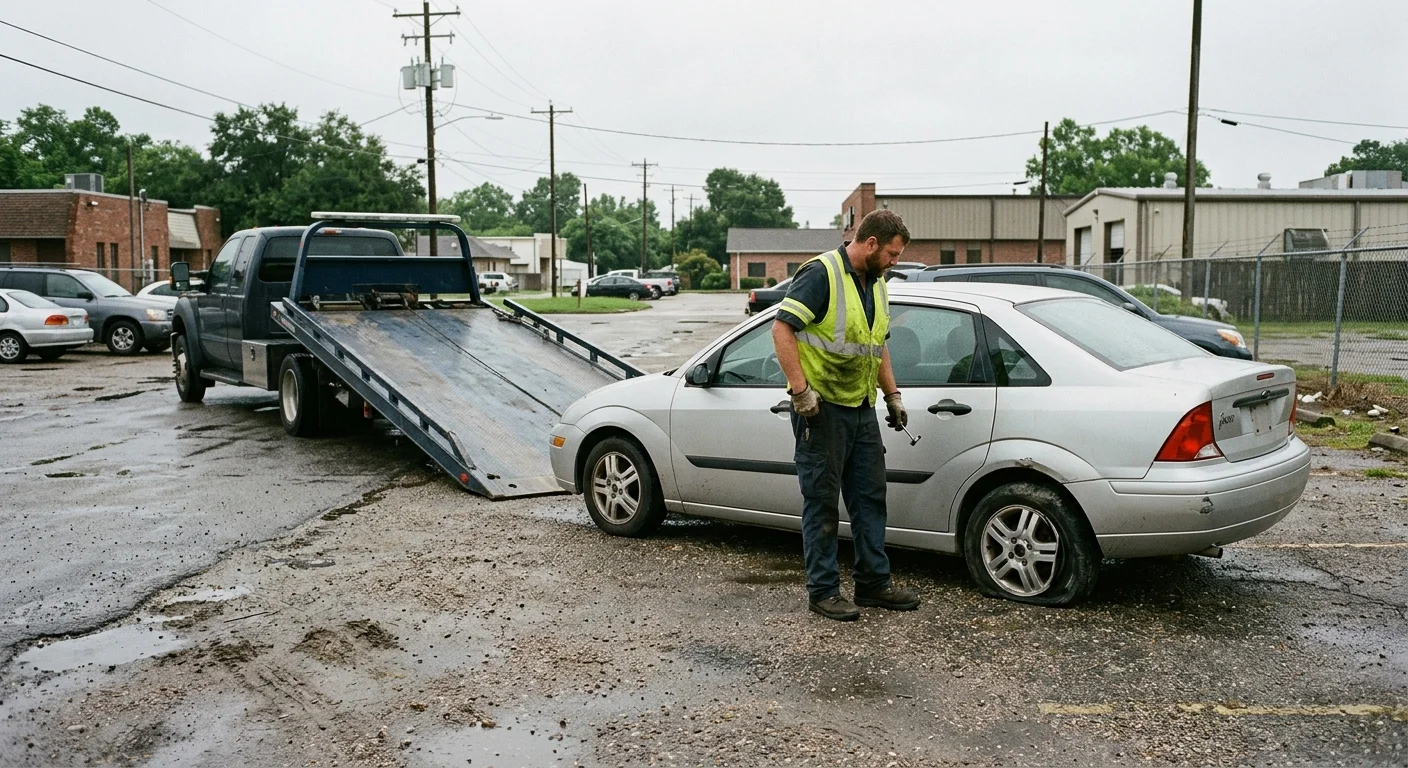
A broken axle leaves one wheel that will not roll, and that is enough to take the car out of traffic. A licensed operator can often still tow a car with a broken axle once they know which corner failed and how the vehicle is sitting. You stay put, describe the damage, and let the operator on scene choose the loading method.
Tell the operator which wheel will not roll
Start the call with the corner. Front left, front right, rear left, or rear right. Say whether the wheel is cocked, tucked under the fender, or sitting on the hub. Say whether any metal is on the pavement.
That one fact shapes the job. A wheel that will not roll cannot be pulled along Elysian Fields, Veterans, or the Westbank Expressway as if it were a flat tire. The operator has to keep that corner from turning, or keep it from scraping, until the car is on a bed.
Name the parish and the road. Orleans, Jefferson, St. Bernard, and the North Shore are different scenes. A dead hub in a Metairie shopping lot is a different approach than a lean on the I-10 high-rise over the Industrial Canal, a shoulder toward Michoud, or a curb on St. Claude. If you are on I-10, I-610, or US-90B, say which lane you occupy and whether traffic is still moving past you.
Leave the car where it sits. A failed axle can let the wheel fold under the body. Trying to limp to a shop on Claiborne or Magazine can take the next hit into the frame, a brake line, or another vehicle.
Get people out of the travel lane if you can reach a shoulder or a parking space. On an interstate, Louisiana’s Move Over rule under R.S. 32:125 tells other drivers to change lanes away from a parked vehicle showing authorized flashing amber, yellow, or green lights, when a lane change is possible with due regard to safety. If a lane change is not possible, or the road is two-lane, the duty is to slow to a reasonably safe speed. A violation can bring a fine not to exceed $200.
If DOTD’s Motorist Assistance Patrol is already on a covered segment of I-10, I-610, I-55, or US-90B, they can protect the scene and move a disabled vehicle out of the travel lane. MAP is a fixed-schedule patrol. It is not a call-out shop tow, and it does not haul the car to a repair bay. Check 511la.org for incidents while you wait.
Add anything else that changes the load: AWD or 4WD if you know it, whether the keys are with you, whether fluid is on the ground, and whether the car still sits level. Skip any plan to jack the corner, chain it to a friend’s pickup, or drag it into a lot. That work belongs to the licensed operator who shows up with the truck.
A damaged axle changes the loading assessment
A rolling car and a car with a dead corner are different loads. Wheel-lift equipment picks up one end and lets the other pair roll. If the damaged axle is on the rolling end, that method fights the failure. The comparison most drivers need is flatbed versus wheel-lift towing.
Flatbed towing keeps all four wheels off the pavement once the car is on the bed. That is often the fit for axle damage, for AWD, or for a hub the operator cannot fully read from the curb. Flatbed towing for axle damage still has a first step: getting the car onto the bed without forcing the broken corner to roll.
That first step is the assessment. Some cars winch on in a straight line. Some sit so low, or so cocked, that the operator needs a different approach, support under the body, or another piece of equipment. There is no single loading method that fits every broken axle. The licensed operator on scene makes that call after they see the wheel.
Check the owner’s materials for your model before anyone talks about a dolly, a shaft disconnect, or a tow mode. Those notes are vehicle-specific. A compact sedan in a Kenner lot is a different load from a three-quarter-ton pickup on the shoulder in New Orleans East. Quick Tow New Orleans matches you with a licensed local operator. The operator owns the truck and chooses the setup.
If this started as a crash, say so early. Crash loading and a quiet mechanical failure are not the same job.
Vehicle position can limit equipment access
The truck has to reach the car. French Quarter and CBD streets are tight. A car nosed into a Poydras garage, a Magazine curb, or a shotgun driveway in the Bywater can block the bed’s approach. The operator needs room to line up, set warning lights, and keep the load path clear.
On the interstate the problem flips. There is space, and there is traffic. A disabled car in the left lane of I-10 toward the Twin Span, or on the Lake Pontchartrain Causeway, leaves little margin. If you are on the Causeway, call Causeway Police at *27 or (504) 835-3116. Causeway Police patrol the bridge around the clock. Fog season runs roughly October through March, and restrictions can close a lane. Reach a Crossover or a Safety Bay if you can do it safely. Crossovers sit roughly every 3.5 miles, with a Safety Bay halfway between each pair.
West Bank lots along the Expressway in Gretna and Harvey, and apartment courts in Terrytown, often have speed bumps, low trees, and parked neighbors. Tell the operator about those before the truck commits to an entrance. A raised parking deck in Metairie or a grass shoulder in St. Bernard changes where a bed can sit.
Flooded pavement is its own stop. New Orleans regularly logs well over 80 thunderstorm days a year. If water is over the road, stay out of it. The National Weather Service warns that 12 inches of rushing water can carry away most cars, and 2 feet can carry away SUVs and trucks. Do not ask an operator to load from a live floodway. Wait for firm ground.
Say whether the car is against a wall, on a grade, in grass, in a live lane, or boxed in by other vehicles. Each of those facts changes the equipment the operator brings.
Crash damage and mechanical failure need different details
A curb, a pavement hit, or a failed joint can break an axle with the rest of the body intact. A crash can break the axle and fold the control arm, the fender, and the brake hose in the same hit. The operator needs that distinction.
For a mechanical failure, report the last thing the car did. A bang on I-10 near Michoud. A clunk leaving a Fat City lot. A wheel that tucked after a hard turn on St. Claude. Say if you heard grinding. Say if the car still sits level. A pothole can be part of that story. Louisiana roads take that kind of hit. We do not have a verified local pothole ranking, and we will not invent one.
For a crash, report airbags, leaking fluid, whether the car is in a live lane, and whether police are on scene. Accident recovery is the path when the car has to come out of a collision scene, not just off a dead hub. St. Charles Parish jobs, including Destrehan, follow the same idea: the scene and the damage dictate the equipment. Our guide to accident towing in Destrehan covers that parish’s roadside pattern.
If a law enforcement officer arranges the tow, Louisiana treats that as a non-consensual tow even when you asked the officer to call. The Louisiana Public Service Commission sets maximum rates for those jobs under General Order 12-20-2024, with the current Attachment A effective for tows on or after April 1, 2026. A tow you arrange yourself with an operator is a private job. Keep those two paths separate when you talk about cost.
Repair cost for the axle itself is a shop question. No verified parts or labor figure sits in our claims file, so we will not invent one. Ask the destination shop after the car is there. Louisiana also does not mandate towing or roadside coverage. Only liability is compulsory. Whether a tow bill is reimbursed turns on your own policy, not on a state towing rule.
What to confirm before the car is moved
Settle the destination before the bed moves. On a private call, that is your call: a shop you name, a driveway, or another spot you and the operator agree on. Name the failed wheel again, and say whether any other corner looks wrong.
Have the keys ready. Say whether the car will go into neutral. A locked transmission is a separate problem from a broken axle. If you know the parking brake status, say that too. Point out fuel, oil, or coolant on the ground.
Pull personal items you want before the car leaves, if you can do it from a safe spot. At a storage yard, Louisiana’s LPSC rules allow no fee for retrieving contents during normal business hours, defined in statute as 8:00 a.m. to 5:00 p.m., Monday through Friday, excluding legal holidays. After hours, the retrieval fee is capped at $64.50. That cap is a storage-yard rule. It is not a promise about the roadside scene.
If the car is AWD or 4WD, check the owner’s materials for tow-mode or transport-mode notes and tell the operator what you found. A photo from a safe spot helps them picture the lean. Stay out from under the car.
If you leave an inoperable car unattended on public property in New Orleans for more than three days, it can meet the City’s abandoned-vehicle definition. Reports go through 311 or nola311.org. If a later City tow is in play, confirm the vehicle and the pickup location with the City at (504) 658-8100, and use the City’s Find My Towed Vehicle page. The City’s July 20, 2026 announcement directs impound payments to 400 N. Claiborne Ave regardless of where the vehicle is held, and vehicles stored over 24 hours may be moved to 10200 Almonaster Ave.
When to call us
Call when a wheel will not roll, the car is in a lane or a lot, and you need a licensed operator to load it. The line takes calls 24/7. Call us at (504) 474-5530 and we’ll connect you with a licensed local operator.