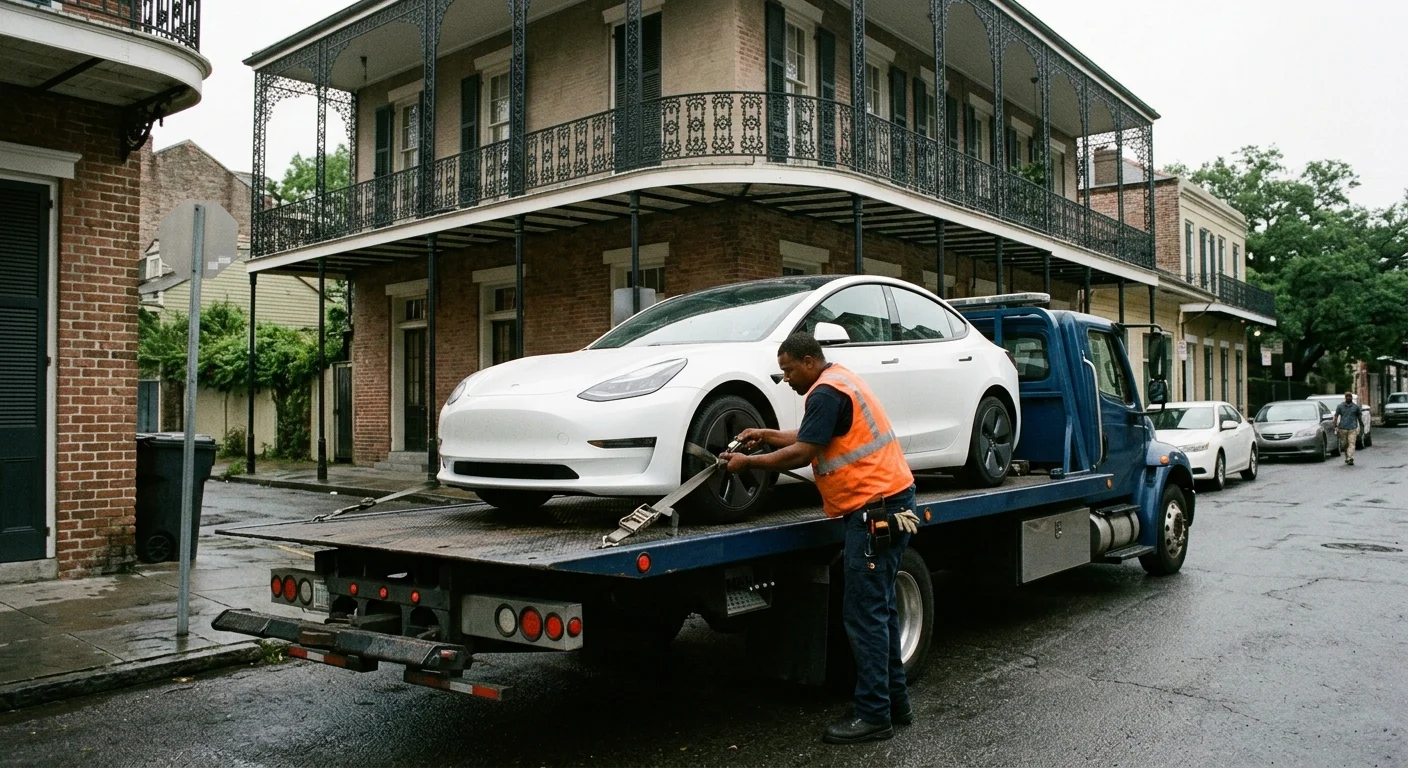
Never tow a Tesla like a gasoline car with driven wheels rolling on the pavement. Follow the owner manual for that year and model. Tesla publishes Tow Mode for a winch-on-bed load. We do not invent Transport Mode tap-and-hold steps. Tesla’s Model 3 transporter instructions recommend a flatbed so all four tires stay off the ground. If a Model 3 must move without a flatbed, Tesla allows a wheel-lift with dollies that keep all four wheels off the ground, only for a maximum of 35 miles and within the dolly speed rating. That is Tesla’s Model 3 rule, not a rule for every EV. A side-by-side OEM comparison is incomplete until a public capture of each maker’s page exists. Our published $95 figure is a light-duty hookup, not an EV-specific rate. See Tesla and EV towing and Tesla Transport Mode vs Tow Mode.
Can Teslas be towed normally: the short answer
Teslas shouldn’t be towed with driven wheels rolling on the road unless the vehicle’s own manual specifically permits that method. For most roadside situations, that makes a flatbed the straightforward choice. The car rides with every tire supported on the truck’s deck.
However, “flatbed only” can be misleading. A wheel-lift truck may sometimes be paired with towing dollies. The lift supports one axle, while the dollies keep the other tires off the pavement. That isn’t the same as pulling the Tesla with two wheels rolling behind the truck.
The distinction matters. A wheel-lift by itself and a wheel-lift with dollies are different setups. Seeing a wheel-lift arrive doesn’t automatically mean the operator plans to roll an axle along the road.
Tesla instructions can vary by model, drive configuration, and model year. Check the towing or transportation section of the official owner’s manual. Follow the procedure written for that exact vehicle. A dashboard setting used during loading doesn’t replace those instructions.
Tell the operator which Tesla you have before the equipment is assigned. Include the model and model year if you know them. Mention whether the display works and whether the car can enter its loading mode.
Our Tesla and EV towing service connects drivers with licensed local operators. The matched operator can compare the vehicle, its condition, and the available loading space before moving it.
What a wheel-lift actually does to a drive unit
A basic wheel-lift raises one axle and leaves the other pair of tires on the pavement. Those tires keep turning throughout the tow. That rolling motion can also turn connected parts within a drive unit.
Putting the car in neutral doesn’t answer every towing question. Neutral may release a parking function or help the car roll during loading. It doesn’t automatically confirm that sustained road towing is allowed. The owner’s manual remains the deciding instruction.
This is why the phrase “tow it normally” causes trouble. A method that works for one vehicle may not suit another drivetrain. The operator needs to know which wheels can roll, which wheels are locked, and whether the car has collision damage.
A flatbed avoids sustained tire rotation during transport. The operator loads the Tesla onto the deck, secures it at approved points, and carries the entire vehicle. Read more about how flatbed towing works when road contact should be avoided.
Loading is still a separate step. A Tesla that won’t power on may not release or steer as expected. A damaged wheel may also prevent a straight pull onto the deck. The operator may need skates, dollies, or another loading tool suited to the scene.
Don’t try to force a locked Tesla to roll with another vehicle. Don’t attach a chain based on a tow point found in a different model’s instructions. Give the licensed operator the manual information and let that operator select the loading method.
Loading a flatbed on a narrow New Orleans street
A flatbed needs more working space than the truck’s parked length suggests. Its deck moves backward and lowers toward the pavement. The operator also needs a clear path between the disabled Tesla and the deck.
That can be difficult on narrow Uptown streets. Parked cars may line both curbs, while oak roots and uneven pavement reduce usable space. Marigny blocks can add tight corners, one-way traffic, balconies, and limited room behind the vehicle.
Tell the phone operator whether the Tesla is parallel parked. Mention if another car sits close to its front or rear bumper. The direction of traffic and the car’s position on the block also matter.
Downtown parking garages create another problem. A flatbed that works on an open street may not clear the garage entrance or upper levels. Read the posted height at the entrance and share it during the call. Also report the garage level, ramp position, and nearest exit.
A licensed operator may need to move the Tesla to an open loading point before placing it on a flatbed. That movement still has to follow the vehicle’s manual. It isn’t permission to drag locked tires across concrete or pull the car through a tight turn without the right equipment.
Photos can make the scene easier to understand. Capture the space around the car, damaged wheels, nearby columns, and the garage clearance sign. Don’t stand in moving traffic to take them.
The goal isn’t simply getting a flatbed to the address. It’s matching the vehicle and location with equipment that can load it without guessing.
Standing water, an EV battery, and the decision not to drive
Standing water changes the decision before towing even starts. Don’t drive into an underpass just to see whether the Tesla can cross. Water can hide pavement damage, stalled vehicles, open drains, and a depth that changes across the roadway.
New Orleans drivers see this risk around low points and underpasses, including areas near Carrollton Avenue. Heavy rain can make a familiar route look passable from the entrance. That view doesn’t show the lowest section ahead.
The record from Hurricane Ida gives the warning real weight. The storm’s one direct fatality in Orleans Parish was a driver who entered floodwater in an I-10 underpass. The lesson isn’t limited to electric cars. Unknown floodwater is a reason to stop, turn around, and choose another route.
Check 511 Louisiana for reported closures, incidents, cameras, and current road conditions. It’s Louisiana’s official traveler-information service. Conditions can still change faster than an online map, so obey barriers and instructions at the scene.
On the interstate corridors it covers, Louisiana DOTD’s Motorist Assistance Patrol gives scene protection and clears disabled vehicles out of travel lanes, though it doesn’t tow a vehicle away for repair. If the Tesla is already in standing water, move yourself to a safe location when that can be done safely. Call emergency services if there’s immediate danger. Don’t open battery components or attempt an electrical diagnosis beside the road.
Tell the towing operator that water reached the vehicle. Describe where it reached on the body and whether the cabin took in water. Mention any warning messages you saw before the display went dark.
Flood exposure can affect how a trained operator approaches, loads, and stores a vehicle. It isn’t a roadside repair experiment. After the scene is safe, follow Tesla’s current guidance for your model and arrange a qualified inspection before driving it again.
What to tell the phone operator before the truck is assigned
Start with the exact Tesla model and model year. If you’re unsure of the year, say so. Don’t choose one that looks close. The operator can work from confirmed information and check the appropriate manual.
Next, describe the car’s condition in plain words. Say whether it powers on, rolls, steers, and responds to the key or phone key. Report any flat tires, broken suspension parts, wheels pointing in different directions, or visible collision damage.
Explain where the vehicle sits. “Downtown garage” isn’t enough. Give the garage level, posted clearance, ramp location, and whether the Tesla faces toward the exit. On a street, mention parallel parking, one-way traffic, nearby intersections, and tight space around the bumpers.
Also tell the operator about these conditions:
- The display is dark or showing a warning.
- The battery charge is very low or unknown.
- The parking function won’t release.
- A wheel is locked, bent, or off the pavement.
- The car is in mud, standing water, or a soft shoulder.
- The tow-eye hardware is present, missing, or unknown.
- Collision damage has affected the front or rear loading area.
Don’t clear warning messages before recording them. A photo of the display may help the operator understand what happened. Keep any owner’s manual instructions available, but don’t attempt a loading sequence while standing in traffic.
If the breakdown happened on I-10 or the Lake Pontchartrain Causeway, roadside safety comes first. Our guide explains what to do after a breakdown on I-10 or the Causeway, including the roles of local road authorities.
The Quick Tow New Orleans line takes calls 24/7. We match drivers with independent, licensed local tow operators. The facts you provide help identify a suitable operator and loading method, but the operator makes the final equipment decision at the scene.
When to call us
Call when your Tesla can’t roll safely, has wheel damage, sits in standing water, or needs loading from a tight street or garage. Call (504) 474-5530. We match you with a licensed local operator who quotes before the truck rolls.