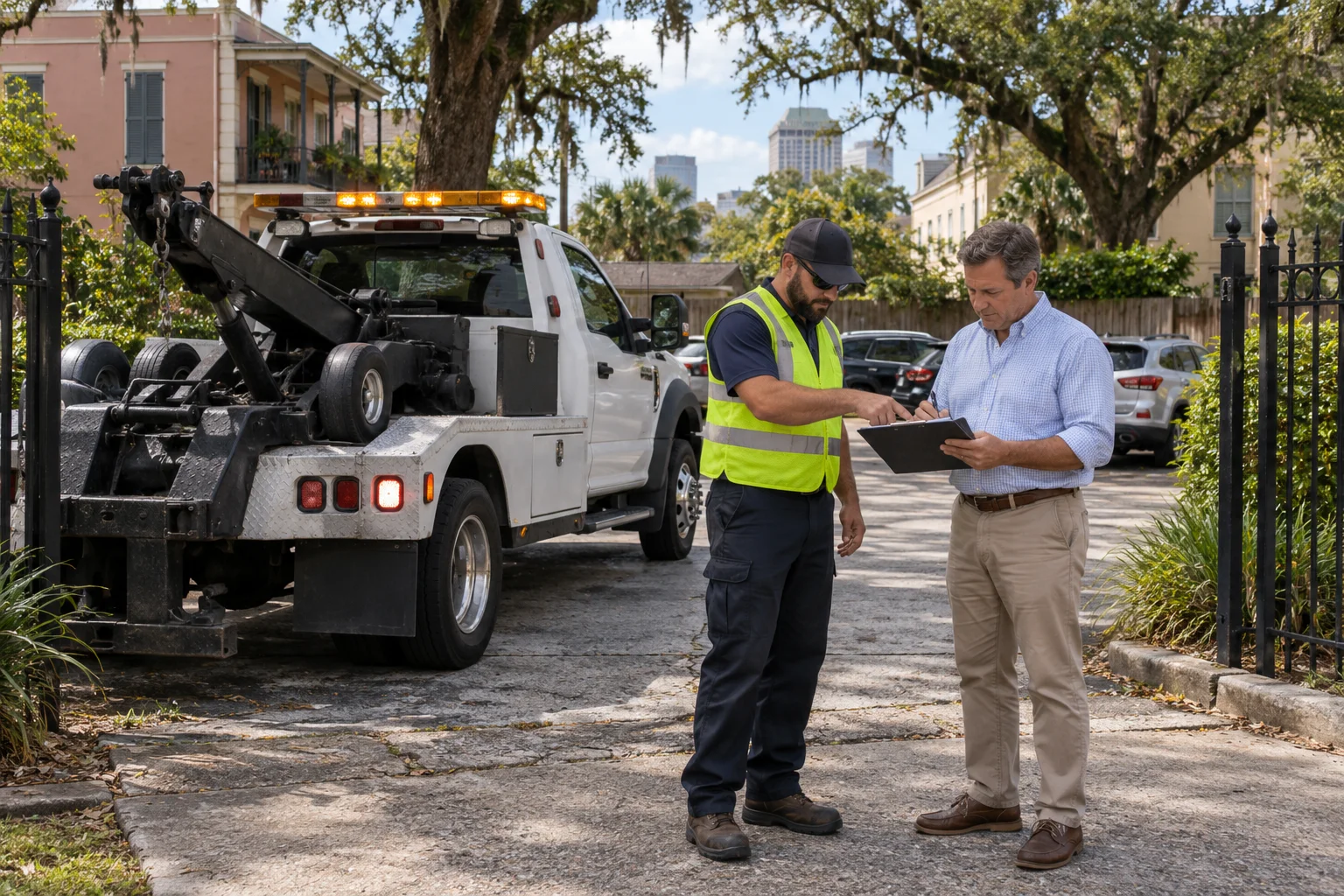
A tow truck can come onto private property when lawful access is available. That doesn’t automatically let the operator remove any vehicle it finds. The answer depends on who requested the tow, whose vehicle is moving, and whether Louisiana’s rules for a nonconsensual removal apply.
The approved Louisiana sources don’t create a blanket right to cross every driveway or enter every private parcel. If access itself is disputed, confirm permission with the property owner or law enforcement before the truck enters.
The answer depends on who requested the tow
Start by identifying the person who made the call. A vehicle owner requesting help with their own disabled car presents a different situation from a landlord, store manager, or apartment representative ordering an unauthorized vehicle removed.
If it’s your car, tell the operator where it sits and who controls the property. A car in your own driveway is straightforward. A car behind an apartment gate, inside a commercial lot, or on property belonging to someone else may require access from the property manager. Owning the vehicle doesn’t necessarily give the operator permission to cross land controlled by another person.
That distinction matters across metro New Orleans. A gated apartment lot in Metairie isn’t managed like a public curb in Orleans Parish. A retail parking area in Kenner isn’t the same as a residential driveway in Algiers. The access question belongs to the person controlling that property.
For an owner-requested move, our private property towing service connects the caller with an independent, licensed local operator. Quick Tow New Orleans can’t grant access to land, approve a removal, or settle an ownership dispute. The matched operator must confirm that the requested work can proceed.
If the vehicle owner didn’t request the tow, stop treating it like ordinary roadside service. A property owner’s request can trigger Louisiana’s rules for nonconsensual towing from a parking area. Those rules address authorization, tags, signs, contracts, invoices, and regulated charges.
Owner-requested and nonconsensual tows are different
An owner-requested tow moves a vehicle with its owner or driver’s agreement. It might involve a dead battery, mechanical failure, collision damage, or a car trapped in a tight parking space. The operator still needs safe and lawful access, but the tow isn’t being forced on the vehicle owner.
A nonconsensual tow happens without the vehicle owner’s permission. Louisiana regulates that category through the Louisiana Towing and Storage Act and the Louisiana Public Service Commission.
This difference controls which rules and rates apply. The LPSC sets statewide maximum rates for nonconsensual towing, recovery, storage, and related fees. Those maximums aren’t Quick Tow’s prices, and they don’t set the price of a tow requested and accepted by a customer.
Private-property removals also shouldn’t be confused with vehicles parked on public streets. A car blocking a private entrance may involve both the property line and curb rules. Our guide to a car blocking a New Orleans driveway explains that separate problem.
The approved claims ledger doesn’t confirm that Louisiana’s parking-area rules automatically cover every private driveway or single-family residence. The statute’s confirmed parking-area scope includes places used for customer, resident, or institutional parking, including shopping centers, businesses, hospitals, apartment complexes, and schools. When a property falls outside that description, don’t guess. Ask the property owner and the law enforcement agency with jurisdiction what authority applies.
Texas, Georgia, Arizona, and other states have different rules. Their signs, timelines, and fee limits don’t answer a Louisiana towing question.
What authorization the operator must confirm
For a nonconsensual tow from a Louisiana parking area, the operator needs one of the triggers recognized by R.S. 32:1736. Law enforcement with jurisdiction may authorize the tow, or the vehicle may be properly tagged for removal.
A proper tag is more than a handwritten warning. The confirmed rule says it must be highly visible and placed conspicuously without damaging the vehicle. It contains the date, time, authorized towing company, and the printed name and signature of the property owner or authorized representative.
The tagging step isn’t required when the property owner or authorized representative signs the billing invoice before the tow. It also isn’t required when the statutory signage requirements are met.
Those signs must appear in clearly visible locations at entrances and exits. Specific parking areas or individual spaces subject to towing must also be marked. When the owner has a towing contract, entrance and exit signs must name the towing company and show its address and phone number. That information must use lettering at least two inches high.
The operator should also confirm who represents the property. Louisiana’s rule says that authorized representative can’t be the tow truck owner or operator. This prevents the towing company from appointing itself as the property owner’s decision-maker.
A written contract is required between the property owner or representative and the towing company. Copies must remain at the property owner’s business office, the towing company’s office, and inside the tow truck. The contract identifies the parking rules, reasons for towing, contact information, and service dates.
For more detail, read our broader guide to Louisiana private-property towing law.
What to document before the vehicle moves
Documentation protects both sides when facts are disputed. Before the vehicle moves, record its position, condition, plate, surrounding parking markings, entrance signs, and any tag attached to it. Capture wide views showing where the car sits, then closer views of relevant signs or damage.
These photos are sensible records, but don’t misstate them as a universal Louisiana photography requirement. The approved sources don’t confirm a general rule requiring photographs before every private-property tow. They do confirm photographic proof for certain booting and specialized recovery situations, which are different matters.
Write down who requested the removal and their connection to the property. If law enforcement authorized it, record the agency involved. If a property representative approved it, preserve their name and the documents they provided. Don’t remove, alter, or damage a warning tag while documenting it.
The tow operator’s billing invoice must include the service date and time, the operator’s name and departure time, the requesting law enforcement agency when applicable, and an itemized list of fees. The LPSC may require additional invoice details.
Don’t treat a blank space, faded sign, or verbal disagreement as proof that a tow is valid or invalid. Preserve what you can see and let the proper authority review it.
If you own the vehicle and find an operator preparing to move it, don’t stand in the truck’s path or touch its equipment. Ask who authorized the tow and where the vehicle will be stored. Record the details from a safe location. A disagreement over authorization should go to law enforcement or the LPSC, not become a confrontation in the parking lot.
Where to check a disputed removal
First determine whether the removal came from private property or a public street. Then identify who ordered it. The storage facility, property owner, law enforcement agency, and tow invoice should help establish that chain.
Louisiana requires a storage operator to notify the sheriff or municipal police within 24 hours after a nonconsensual tow from private property. The notice identifies the vehicle, where it was removed, and where it was taken. That requirement gives drivers a place to start when a car seems to have disappeared.
For a private-property dispute, ask the property owner or manager for the parking rule involved. Photograph every entrance, exit, marked space, tag, and posted towing sign. Request an itemized invoice from the towing company. A copy of the invoice doesn’t require payment first.
Check the charge against the current LPSC nonconsensual towing schedule. The schedule changes through an annual adjustment process, so use the version effective on the tow date.
Every invoice must provide the LPSC complaint information. A vehicle owner doesn’t have to pay the invoice before gaining standing to complain. If a written complaint later establishes excessive charges, storage fees stop accruing from the complaint date. The Commission may also order a refund of up to 200 percent of an overcharge.
Public-agency tows have a separate hearing process. An owner whose vehicle is stored by a public agency may request a hearing from the agency that ordered the tow. That right shouldn’t be presented as a general hearing for every private-property removal.
When to call us
Call when you need your own disabled vehicle removed from private property with confirmed access. The line takes calls 24/7, and Quick Tow New Orleans matches drivers with independent, licensed local tow operators. Call us at (504) 474-5530 and we’ll connect you with a licensed local operator.