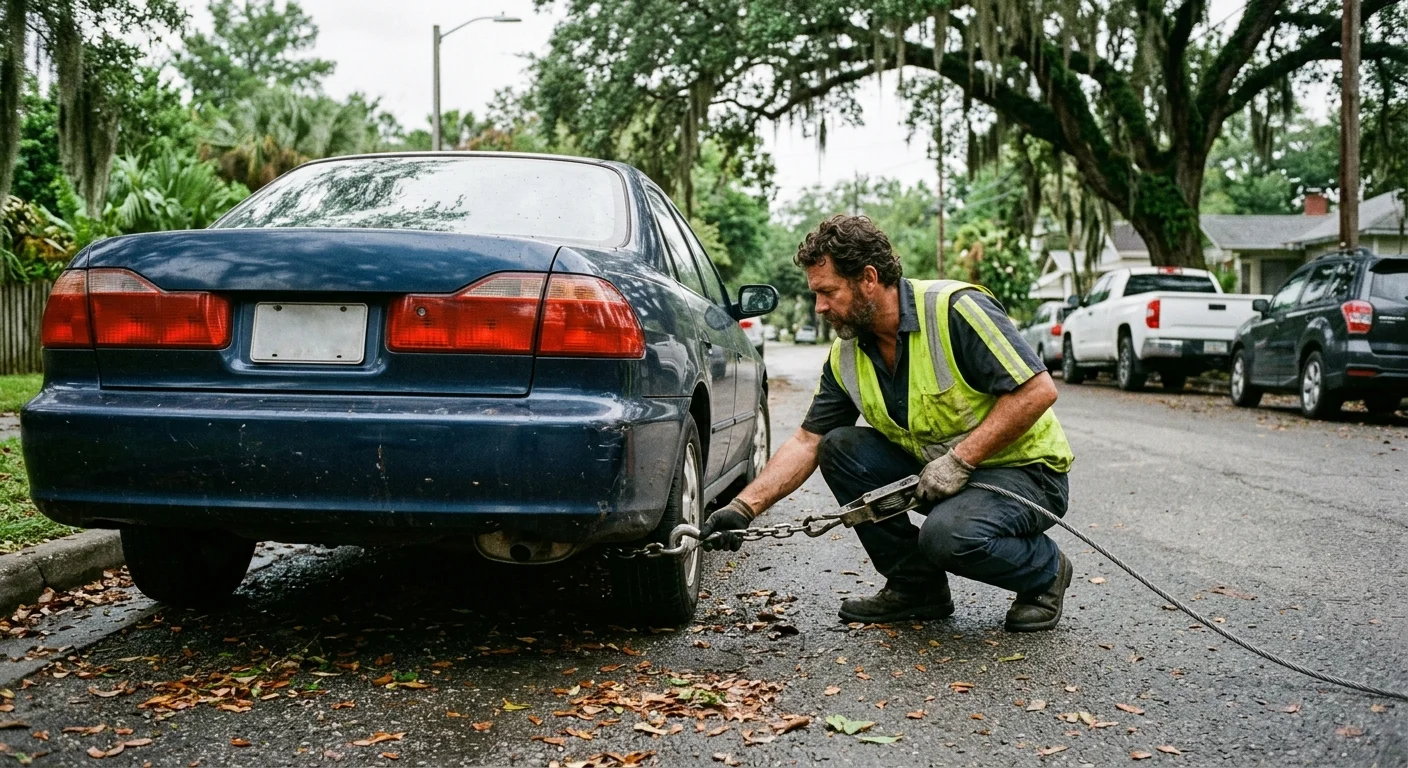
Expired tags are not a tow reason for an otherwise legally parked car. Louisiana has no general rule letting an officer tow solely because registration expired. A narrow exception applies at weighing and inspection stations. It does not create a street-parking tow. For City custody after a different violation, see what changes at a city yard. For a lot tow, see Louisiana private-property towing law. We do not publish City storage or boot dollars.
Can your car get towed for expired tags in Louisiana
Louisiana has no general rule allowing police to impound a parked car solely because its registration has expired. That answer applies when the vehicle is otherwise legally parked and hasn’t been treated as abandoned.
The rumour persists because expired registration often appears beside another problem. A car may also be parked illegally, left unattended, disabled on public property, or marked for removal from private property. When it gets towed, the expired plate becomes the most visible explanation. The actual towing authority may have been something else.
That distinction matters across the New Orleans metro. A sedan parked legally on a residential street in Mid-City isn’t in the same situation as one violating a parking restriction downtown. A car at a Metairie apartment complex also falls under different removal circumstances than one stored by a public agency in Orleans Parish.
Start by identifying who ordered the tow. Check any notice, towing invoice, parking citation, or removal tag. Don’t assume the registration sticker tells the whole story.
If a vehicle disappears from an Orleans Parish street, use the City’s Find My Towed Vehicle page. Our guide to finding a towed car in New Orleans also explains how to separate a City impound from a private-property tow.
The accurate answer is therefore conditional. Expired tags alone aren’t a confirmed towing trigger for an ordinary parked car. A separate parking, abandonment, or private-property issue can still support removal.
The one statute that ties impoundment to registration
Louisiana R.S. 47:516 is the confirmed statute connecting registration status with impoundment. Its reach is much narrower than the common rumour suggests.
The statute concerns enforcement at weighing and inspection stations. It gives authority to the commissioner, the division of state police, or DOTD weights and standards police officers. At one of those stops, an improperly licensed vehicle may be impounded when its registration is expired or missing.
The operator must then buy the proper registration on the spot. A DOTD stationary scales officer also has another option. Instead of impounding the vehicle, that officer may issue a $75 ticket that gives the operator five days to comply.
That $75 figure belongs only to this narrow statutory alternative. It isn’t a general expired-tag ticket, towing price, or New Orleans impound fee.
Nothing in the confirmed text extends that power to an ordinary traffic stop away from a weighing or inspection station. It also doesn’t authorize officers to search residential streets for cars with old stickers and tow them on that fact alone.
The setting is the key. A car stopped at a covered weighing or inspection station can face the specific choices described in R.S. 47:516. A legally parked car beside a home in Gentilly isn’t in that setting.
This is why broad online claims cause trouble. Saying that Louisiana can always impound a vehicle for expired tags removes the limits written into the statute. The confirmed rule is station-specific, officer-specific, and tied to improper registration enforcement there.
What lapsed tags actually cost you
For ordinary lapsed registration, the confirmed consequence appears in R.S. 47:508. A Louisiana-domiciled vehicle operating with expired or absent registration receives a penalty equal to 25% of its annual registration cost. That amount is added when the registration is renewed.
It isn’t 25% of the car’s value. It also isn’t one flat statewide dollar amount for every vehicle. The base is that vehicle’s annual registration cost, so owners should confirm their actual renewal amount through Louisiana OMV.
That financial penalty doesn’t become towing authority by itself. Paying a renewal penalty and recovering an impounded vehicle are separate issues. If your vehicle was removed, find the stated reason instead of assuming the renewal charge caused the tow.
The practical move is to address expired registration before driving again. Gather your current vehicle records and confirm what OMV requires for renewal. If the car can’t be driven safely or legally while you handle the paperwork, a licensed operator can move it without turning the trip into another roadside problem.
Quick Tow New Orleans is a matching service, not the towing company. Our line connects drivers with independent, licensed local operators. The operator performs the work, sets the applicable price, and receives payment directly.
Our emergency towing service page explains when a disabled vehicle may need professional transport. The line takes calls 24/7, but that availability isn’t a promise about when an operator will reach a location.
Most importantly, don’t treat the renewal penalty as proof that every expired-tag vehicle can be impounded. R.S. 47:508 addresses the financial consequence. R.S. 47:516 supplies the narrow station-based impoundment exception.
Where a real tow can still come from
Expired tags don’t protect a vehicle from removal for a separate violation. The tow must rest on that other basis, not merely the registration date.
New Orleans defines an abandoned vehicle to include one left on a public street in violation of a parking law. The City also includes an inoperable, unattended vehicle left on public property for more than three days. A car meeting either condition presents a different question from a legally parked, operable car with an expired registration.
Louisiana R.S. 32:473.1 supplies the general public-street process when an officer finds a vehicle abandoned. The officer posts a notice on the windshield directing removal within 24 hours. If the vehicle isn’t moved, the municipality, parish, or an operator acting for it may remove and store it.
The finding of abandonment is what starts that process. An old registration sticker alone doesn’t replace it.
Private parking areas have their own rules. Under R.S. 32:1736, a non-consensual tow from a parking area requires law-enforcement authorization or the vehicle being properly tagged for removal. Property owners must also post entrance and exit signs identifying the towing company, its address, and its phone number in lettering at least two inches high.
A removal tag in that statute isn’t the vehicle’s registration tag. It means the vehicle was marked for towing under the private-property process. Confusing those two uses of “tag” is another source of the rumour.
A real tow can therefore result when the same expired-registration vehicle is illegally parked, found abandoned, or properly marked for private-property removal. The registration lapse remains separate from the towing basis.
If the vehicle is unwanted rather than impounded, review the options for junk car and abandoned vehicle removal. Disposal and title steps still need to be handled correctly. An unwanted car shouldn’t simply be left on a New Orleans street or parking lot.
Louisiana’s posture on impoundment is narrow by design
Louisiana’s statutes address impoundment through specific circumstances. They don’t establish one open-ended rule allowing every vehicle violation to result in a tow.
R.S. 32:392(A)(1) illustrates that approach. When a vehicle violates size, weight, and load provisions, the statute says it isn’t impounded. Instead, it is directed and escorted to the nearest suitable unloading point at the owner’s expense.
That section isn’t a registration rule. It shouldn’t be used to decide an expired-tag case. It shows why each towing claim must trace to the statute governing that exact situation.
The same care applies after a tow. Louisiana’s Towing and Storage Act creates a detailed framework for stored vehicles, notices, operators, and non-consensual towing. An invoice for a private-property tow must be itemized. It must identify the service date and time, the operator, applicable law-enforcement agency, and individual fees.
For a vehicle stored by a public agency, R.S. 32:1727 provides a limited administrative hearing right. The owner must request that hearing within ten days after the required notice was mailed. The request goes to the agency that ordered the tow by certified mail, return receipt requested. The hearing addresses whether the tow and storage were proper.
That right doesn’t apply generically to every private tow. It also doesn’t promise damages or automatic release. The statute provides a determination of whether the public-agency tow and storage were proper.
When checking an expired-tag tow, focus on the written authority. Was the vehicle at a covered weighing station? Was it violating a parking law? Had an officer found it abandoned? Was it lawfully marked for private-property removal? If none applies, expired registration alone isn’t a confirmed Louisiana towing trigger.
When to call us
A disabled vehicle, unsafe parking position, or required relocation may call for a licensed towing operator. The line takes calls 24/7. Call (504) 474-5530. We match you with a licensed local operator who quotes before the truck rolls.