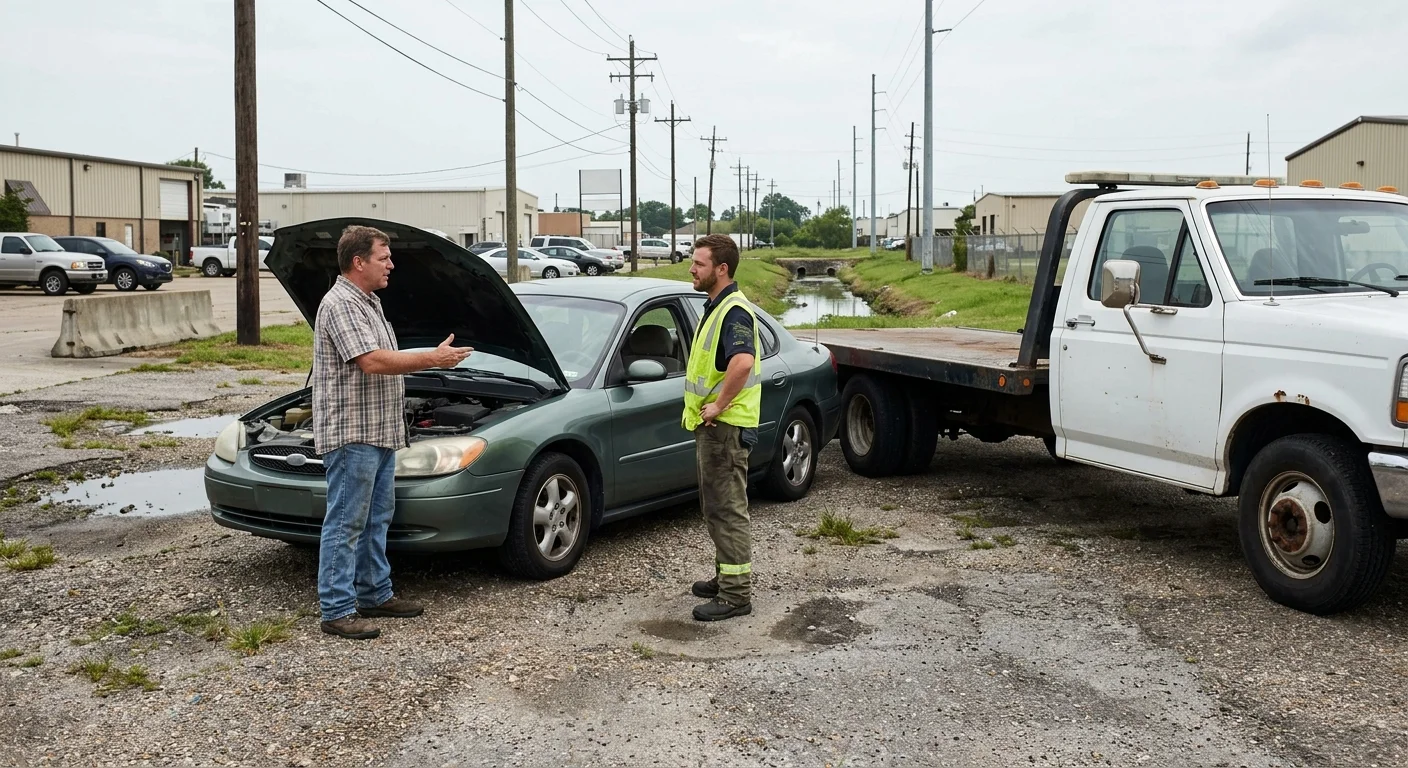
Do not force the shifter into neutral. Report the transmission type (automatic, manual, AWD) and whether the wheels lock. The operator may use a flatbed or dollies rather than dragging locked wheels.
Tell the operator the car will not roll
A car stuck in Park isn’t a routine rolling pickup. Make the problem clear before an operator heads toward you. Say, “The car won’t shift into neutral, and it won’t roll.”
Describe what happens when you move the selector. It may stay fixed, move without changing the dashboard indicator, or trigger a warning message. You don’t need to diagnose the cause. The operator needs the symptoms you can see.
Share these details during the call:
- The year, make, model, and body style
- Whether it’s front-wheel, rear-wheel, or all-wheel drive
- Whether it’s electric, hybrid, or gasoline-powered
- The displayed gear and any warning messages
- Whether the steering wheel turns
- Whether the wheels point straight or toward a curb
- Whether you have the key or electronic key fob
- The car’s exact position and nearby obstacles
Mention any collision damage, flat tires, or visibly damaged wheels. Tell the operator if the car sits nose-first against a wall. A car stranded beside I-10 creates different access concerns than one parked in an open Metairie lot.
This information helps the matched operator evaluate flatbed towing and other loading options. It also reduces surprises when the vehicle can’t move under its own power.
If you’re in an active travel lane, focus on emergency instructions first. Call 911 when there’s immediate danger. For current closures and incidents, check the official 511 Louisiana traffic service.
Vehicle instructions come before a generic workaround
The owner’s manual comes before an online shortcut. Manufacturers set model-specific procedures for towing, transport modes, electronic parking brakes, and emergency gear selection.
Look in the manual under “towing,” “vehicle transport,” “neutral,” or “shift lock.” Share the relevant page with the operator. A clear photo is useful when the paper manual stays in the glovebox.
If you don’t have the manual, check the manufacturer’s official website or app. Use the exact year, model, and trim. Don’t rely on instructions written for a similar-looking vehicle.
Avoid removing trim, pulling hidden cables, inserting tools, or disconnecting parts. Those steps can turn a towing decision into an attempted repair. They may also conflict with the manufacturer’s instructions for your exact car.
Electric vehicles need the same model-specific approach. Terms such as transport mode and tow mode don’t mean the same thing across every brand. For a Tesla, start with our guide to Tesla Transport Mode versus Tow Mode, then confirm the current instructions for your model.
Take photos of the selector, dashboard warnings, wheel position, and manual pages. Send or show them to the assigned operator. If the manual’s procedure isn’t available or can’t be completed, say so plainly.
The goal isn’t to make the car roll at any cost. It’s to give the licensed operator enough information to plan loading without guessing.
Wheel position and access affect the loading plan
The answer to how to tow a car that will not roll depends partly on its position. Locked wheels are only one part of the problem. Steering position and surrounding space also shape the operator’s plan.
Check the car without trying to move it. Note whether the front wheels are straight, turned toward a curb, or pressed against something. Report any wheel that looks tilted, collapsed, or blocked. Mention how much open space sits ahead of and behind the car.
A flatbed doesn’t automatically make every stuck-in-Park vehicle simple to load. The operator still needs a safe path between the vehicle and the truck. The wheel angle, drivetrain, clearance, and manufacturer guidance all matter.
A wheel-lift towing setup may be considered in some situations. The operator may also determine that another loading method or supporting equipment is needed. Don’t assume the nearest visible tow truck is suitable.
Our guide to flatbed versus wheel-lift towing explains the basic equipment differences. The assigned operator must still choose a method for the vehicle in front of them.
Don’t attach a rope or strap to another car. Don’t ask bystanders to push locked wheels across pavement. Leave movement and equipment placement to the towing professional.
Before loading starts, ask the operator to explain the plan in plain language. Confirm which wheels will be supported and whether anything must change first. If the plan conflicts with the owner’s manual, stop and address that conflict before the vehicle moves.
Garages and narrow streets add constraints
A disabled car inside a CBD garage presents a different job than one in an open Kenner lot. Low ceilings, tight ramps, gates, columns, and sharp turns may limit how the operator reaches the vehicle.
Report the posted garage clearance exactly as shown. Don’t estimate it. Give the garage name, entrance location, level, stall number, and direction the car faces. Mention access cards, locked gates, payment arms, and one-way ramps.
Tell the operator whether the car is nose-in or backed into the space. Measure nothing unless you can do so safely. A photo showing the full parking bay often communicates more than a verbal description.
A narrow New Orleans street brings another set of constraints. A car boxed into a French Quarter curb space offers less working room than one in a large Metairie parking area. Tight Uptown blocks, nearby streetcar tracks, parked vehicles, and loading zones can also affect positioning.
Parade barricades, festival closures, and construction may block the usual approach. Share the cross street and the direction traffic can enter. Don’t assume the operator can use the same route you drove earlier.
If garage staff controls access, contact them before loading begins. Ask about gates, posted vehicle restrictions, and the approved exit route. Don’t ask staff to push or reposition a car that remains locked in Park.
Our guide to towing a car from a New Orleans parking garage covers the access details worth collecting. The more accurately you describe the space, the better the operator can assess the job.
What to confirm before loading begins
Pause for a final review before equipment touches the car. Repeat that the vehicle won’t shift into neutral and can’t roll normally. Make sure the operator has seen any dashboard warnings and manufacturer instructions.
Confirm these points together:
- The exact vehicle and drivetrain
- Which wheels appear locked or damaged
- The steering position
- Whether the key or fob is available
- What the owner’s manual says about transport
- The pickup position and available working space
- The destination authorized by the vehicle owner
- The loading method selected by the operator
Ask the operator to explain any step you don’t understand. Don’t attempt a manual release or electronic procedure unless it matches the manufacturer’s instructions and the operator agrees it belongs in the loading plan.
Photograph the car’s exterior before loading. Include the wheels, bumpers, and any existing damage. Keep personal items secure, move bystanders away from the working area, and follow the operator’s directions.
Ask the independent operator about charges and payment before work begins. Quick Tow New Orleans doesn’t set operator prices. You contract with and pay the matched operator directly.
Also confirm the destination. A repair shop may have its own receiving hours, entrance, or key-drop process. Contact the destination yourself if those details haven’t been verified. Don’t assume the property will accept an unattended vehicle.
Once the plan is clear, let the licensed operator control the loading. A car stuck in Park needs a towing decision based on its actual condition, not a universal bypass.
When to call us
Call when the car won’t enter neutral, the wheels stay locked, or the location makes loading uncertain. The line takes calls 24/7. Call (504) 474-5530. We match you with a licensed local operator who quotes before the truck rolls.