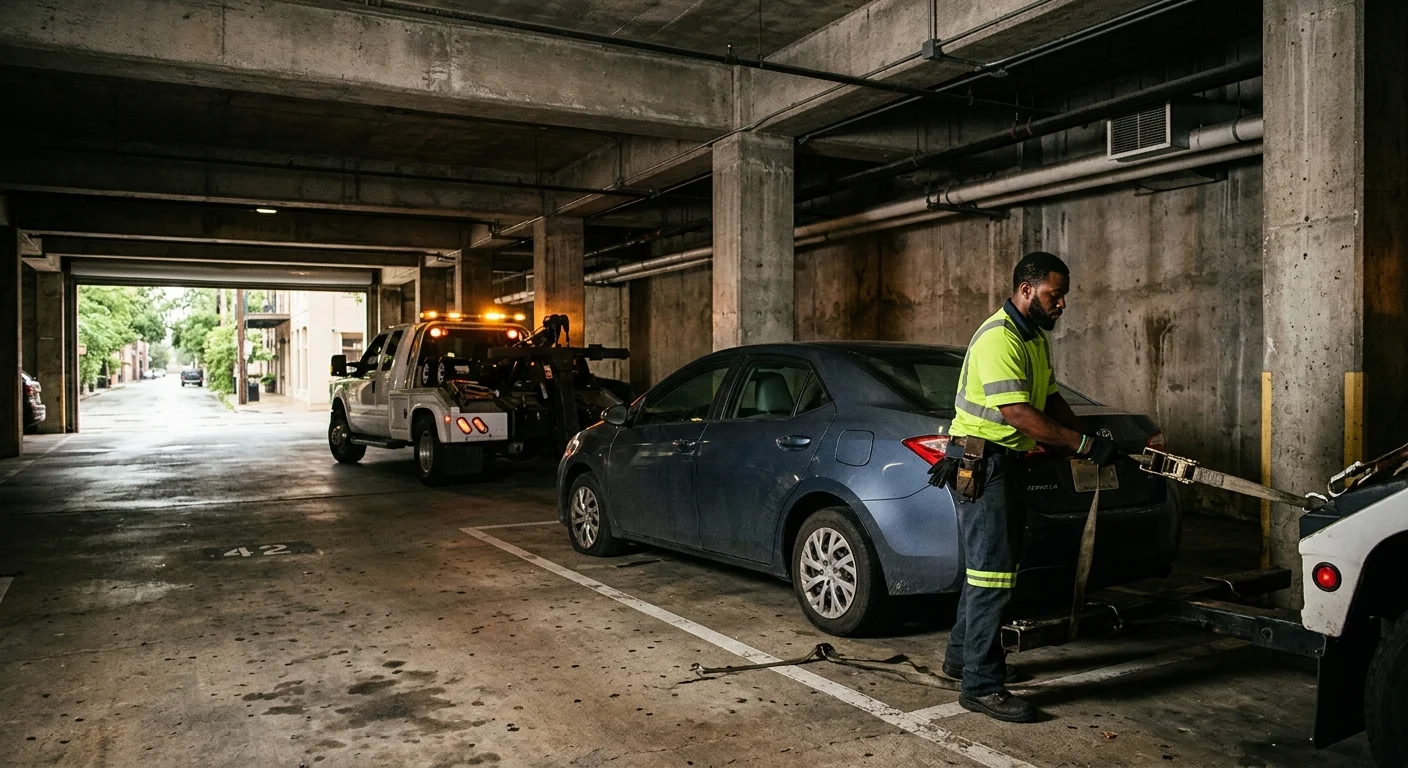
Lead with garage height, stall width, and whether the car rolls. See wheel-lift on a parallel-parked car and low-clearance towing. We do not invent CBD garage names or fees.
Start with the garage level and exact space
“Inside a parking garage” isn’t enough information for an operator. The first level near an open entrance presents a different problem than an upper level reached by narrow ramps.
Start with the garage name or street address. Then report the level, row, and space number. If the spaces aren’t numbered, identify nearby elevators, stairwells, columns, or entrance lanes. Tell the operator whether the car faces a wall, a column, or the driving aisle.
Garage layouts matter throughout New Orleans. A vehicle inside a CBD structure may sit several turns from the street. A French Quarter garage may have a different entrance, exit, and loading route. Don’t assume the tow vehicle can use the same path you drove.
Explain how the car entered the space. A sedan that pulled straight into an open stall may be easier to reach than one backed tightly against concrete. Mention cars parked on both sides. Also report any curb, wheel stop, pipe, or low beam near the vehicle.
Photos can clear up uncertainty before equipment is selected. Take wide photos from the driving aisle and both sides of the car. Include the route from the stall toward the nearest exit. Avoid photographing other drivers or readable license plates when possible.
Share your location inside the structure, not only the street address. That simple detail helps the matched operator evaluate access before bringing equipment into the garage.
Clearance and access affect the equipment choice
The posted entrance clearance is the first measurement to report. Photograph the sign rather than relying on memory. If separate entrances or levels display different limits, capture each one along the likely route.
Overhead height isn’t the only restriction. Operators also consider ramp slope, turning space, lane width, speed humps, pipes, gates, ticket arms, and ceiling changes. A truck that clears the entrance could still encounter a tighter point deeper inside.
There isn’t one universal tow truck for a low-clearance garage. A wheel-lift towing setup may fit some structures and vehicle positions. It lifts one end of the vehicle while the other end rolls. However, drivetrain type, wheel damage, steering position, and manufacturer instructions may change that plan.
A flatbed tow carries the vehicle with its wheels off the road. That can suit many vehicles, but the truck needs enough height and working room. Its deck movement and loading angle also require space. A flatbed isn’t automatically the right answer inside every garage.
Our guide to flatbed versus wheel-lift towing explains the basic differences. For a garage job, access comes before preference. The matched operator decides which method fits the structure and vehicle.
Never direct a tow truck past a posted restriction. Let the operator review the route and make that call.
Vehicle position and wheel condition still matter
Garage clearance gets attention, but the vehicle itself controls much of the job. Tell the operator what failed and whether the car can roll, steer, or shift into neutral.
A dead battery may leave an electronic parking brake engaged. A damaged wheel can prevent normal rolling. Collision damage may lock the steering or push a tire against the body. Missing keys can also change how the vehicle must be handled.
Report whether the vehicle is front-wheel drive, rear-wheel drive, all-wheel drive, or four-wheel drive if known. Don’t guess. The owner’s manual or vehicle information may provide the answer. Electric vehicles and some newer cars can have specific transport procedures.
The stall position matters just as much. Tell the operator if the drive wheels face the wall. Mention whether the steering wheel is turned or the transmission is stuck in park. Include any fluid beneath the car, visible suspension damage, or tire resting against a curb.
Don’t crawl under the vehicle to inspect it. Don’t release a parking brake unless the operator or vehicle manual gives safe instructions. A car can roll unexpectedly on a garage ramp.
Our guide to towing a low-clearance car covers ground clearance around bumpers and body panels. That’s separate from garage ceiling clearance. Both measurements can affect the method.
The matched operator, not Quick Tow, chooses the equipment and performs the removal. Clear photos and accurate details help that operator assess the job.
Confirm garage access before arranging the tow
Call the garage office, attendant, property manager, or security desk before arranging entry. Ask where towing vehicles enter and whether staff must open a gate. Confirm how the tow vehicle will exit after loading the car.
Some questions don’t have one citywide answer. New Orleans doesn’t set a universal access policy for every private garage. The garage owner or manager controls its own entry procedures. We couldn’t confirm a single rule covering ticket validation, loading areas, or operator access across all CBD and French Quarter garages.
Ask the property contact about:
- The approved entrance and exit
- Gate, ticket, or access-card procedures
- Any restricted ramps or closed levels
- A place where the operator can meet you
- Permission needed to work in the driving aisle
- Steps for moving nearby vehicles, if required
Don’t promise that another car can be moved. Only garage staff or that vehicle’s owner can address it through the proper process.
If you’re arranging removal of someone else’s vehicle, stop and confirm your authority. Louisiana’s private-property towing law addresses nonconsensual towing from parking areas, including authorization, tagging, contracts, and signs. A property-enforcement tow isn’t the same as requesting help for your own disabled car.
If your car is missing rather than disabled, contact the garage first. If staff says the City removed it, the City’s Find My Towed Vehicle page explains how to check its location.
What to report to the matched operator
A short, accurate report is more useful than a general request. Begin with the garage address and the exact location of the car. Then describe the route and the vehicle’s condition.
Have these details ready:
- Garage name and street address
- Entrance street, if the garage has several
- Posted clearance at the entrance and along the route
- Level, row, and space number
- Ramp direction and any tight turns
- Whether the car rolls, steers, and shifts into neutral
- Parking-brake status
- Drivetrain type, if confirmed
- Damaged, flat, or locked wheels
- Vehicle make, model, and approximate size
- Keys and garage ticket availability
- Garage contact or access instructions
- Photos of the entrance, route, stall, and vehicle
Tell the operator about anything unusual. That includes a vehicle facing a wall, a low front bumper, an attached bike rack, or cargo changing the vehicle’s height. Mention standing water, leaking fluids, broken glass, or collision debris without approaching a hazard.
Stay in a safe pedestrian area while the operator works. Don’t stand between the vehicle and a wall. Don’t enter the truck’s working zone or attempt to guide a rolling car by hand.
Quick Tow New Orleans matches drivers with licensed, independent local operators. The line takes calls around the clock. The matched operator reviews the garage conditions, selects the equipment, performs the tow, and charges the customer directly.
When to call us
Call when a disabled car can’t leave a CBD, French Quarter, or other New Orleans garage under its own power. Have the clearance, level, space, vehicle condition, and garage instructions ready. Call (504) 474-5530. We match you with a licensed local operator who quotes before the truck rolls.