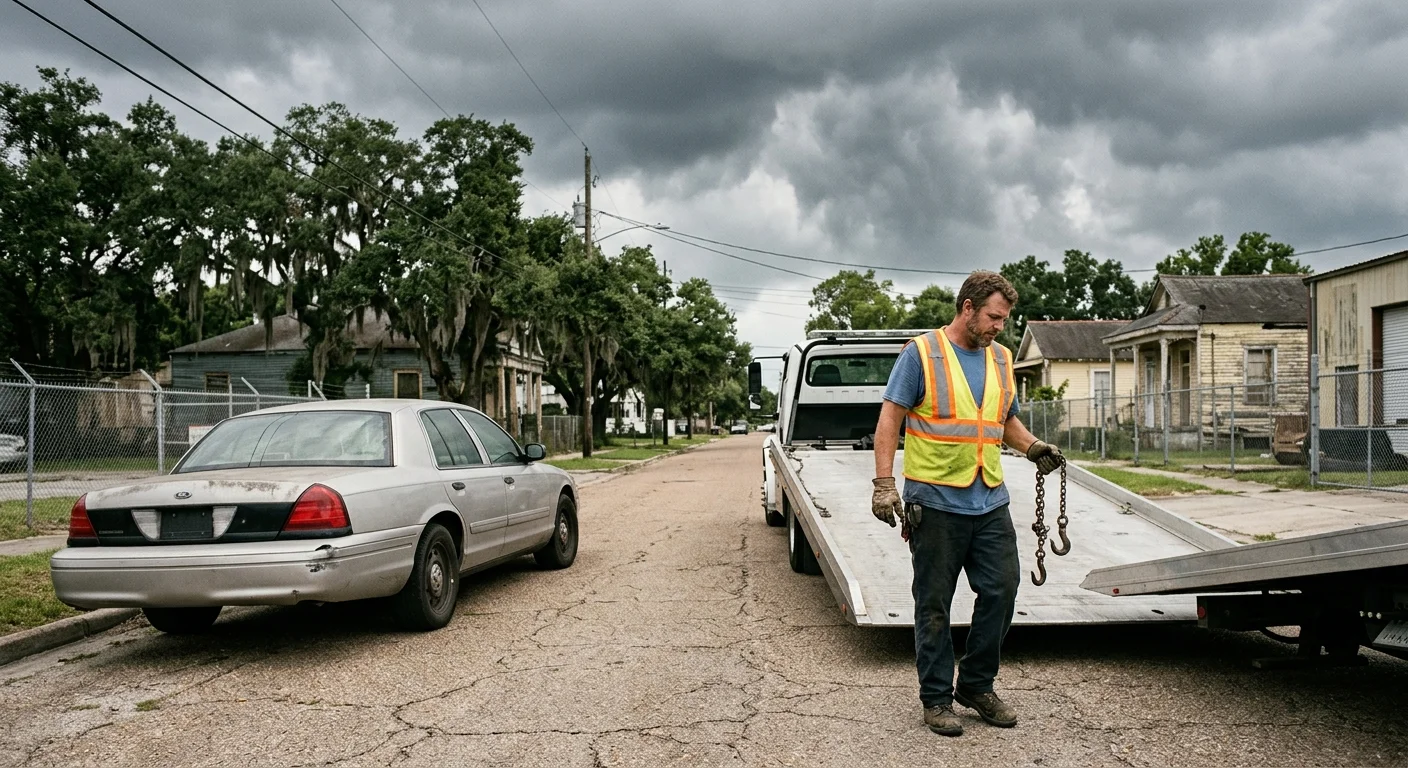
The right time to tow a disabled car before a hurricane is while the pickup point and route remain safely usable. Move it when its current location may become exposed, inaccessible, or obstructive. Leave it only when current official guidance supports that choice and moving it would add risk.
Start with whether the car can move safely
A running engine doesn’t make a car roadworthy. Start with steering, brakes, tires, visibility, and any leaking fluid. If any of those are uncertain, don’t test the car in traffic.
Dashboard warnings also need context. A weak battery might allow one start but not another. An overheating engine could stop again between Orleans Parish and Jefferson Parish. A damaged tire may fail before the car reaches its planned destination.
Don’t drive merely to avoid arranging a tow. That can turn a controlled relocation into a roadside emergency. It can also leave the car somewhere harder for an operator to reach.
The car’s present position matters just as much. A vehicle parked on dry private property presents a different decision from one beside I-10, I-610, or US-90B. If it’s in a travel lane or another exposed roadway position, protect people first. Follow law enforcement directions and don’t push the vehicle through traffic.
The DOTD Motorist Assistance Patrol can move disabled vehicles from travel lanes and provide minor help on covered routes. MAP follows a fixed patrol schedule, however. It isn’t a call-out towing service and doesn’t tow vehicles away for repairs.
If the vehicle cannot move safely under its own power, treat it as a towing job. Give the operator an honest description of its condition. Mention locked wheels, steering damage, missing keys, low clearance, or blocked access. Those details help the operator decide whether the job fits available equipment.
Choose a destination outside the immediate flood risk
A good destination must satisfy two separate tests. It needs to accept the vehicle, and current official information must support access to it.
Don’t name a neighborhood based on reputation alone. Kenner, Metairie, the West Bank, Orleans Parish, and St. Bernard Parish aren’t interchangeable. Conditions and access can differ within each area. No repair shop, driveway, garage, or parking lot is automatically safe during a storm.
Confirm the complete address with the property owner or repair shop. Ask whether the gate will be open and where the vehicle may be placed. If nobody will be present, confirm key handling and after-hours drop instructions. Get permission before using someone else’s lot.
A home driveway may work when it remains accessible and the owner approves. A repair facility may be better when the car already needs mechanical work. For a move beyond the immediate metro, discuss long-distance towing with the independent operator.
Check the planned route on Louisiana 511 before authorizing the move. It provides official incident, closure, construction, weather, camera, ferry, and movable-bridge information. Check again if the route or destination changes.
Don’t ask an operator to unload in standing water or behind a closed route. Choose another confirmed destination when access is doubtful. If no suitable location can be confirmed, say that plainly during the call. The matched operator can then decide whether another plan is workable.
The goal isn’t simply getting the car away from your home. It’s placing it somewhere authorized, reachable, and suitable under current guidance.
A planned move differs from an emergency recovery
A planned pre-storm move starts with a dry pickup point, a confirmed destination, and a vehicle that isn’t trapped. The operator can review the route and vehicle condition before accepting the work.
An emergency recovery starts from a different position. The car may be stranded beside traffic, blocked by debris, sitting on soft ground, or exposed to water. Those details can change the equipment required. They can also make the job unsafe to accept.
Never enter floodwater to attach a chain, inspect a wheel, or retrieve an item. Don’t drive around a flood barrier. If water has reached the vehicle, stop treating the job as a routine relocation. Read what to do when your car floods in New Orleans before attempting to start or move it.
Tell the operator what has changed since the car stopped. Share whether water reached the cabin, wheels, or engine area. Describe visible debris, soft shoulders, garage clearance, and nearby power lines without approaching a hazard. Photos taken from safe, dry ground may help explain the scene.
For a roadway breakdown or developing hazard, use the emergency towing service request path. That describes the service needed, not a promised response window. Quick Tow New Orleans matches callers with independent, licensed local operators. Each operator decides whether to accept the job based on conditions and available equipment.
Ask the operator to explain the planned method and charges before authorizing work. Quick Tow doesn’t set operator prices, collect towing payments, or warrant an operator’s work. You contract with and pay the matched operator directly.
Parish lines and lake crossings affect the request
Metro New Orleans crosses several distinct road networks. A short move within Orleans Parish isn’t the same request as a trip from the West Bank to the North Shore. State the pickup parish and destination parish at the beginning of the call.
Routes matter too. I-10 and I-610 shape many South Shore moves. US-90B serves a different approach across the West Bank. A North Shore destination may require a lake crossing or a longer route around Lake Pontchartrain. Don’t assume yesterday’s route remains usable.
The Lake Pontchartrain Causeway has its own police department and published breakdown procedures. The bridge is patrolled around the clock. A driver stranded on it should follow Causeway Police directions using the contact information on the Causeway’s official site.
A disabled vehicle near a Causeway crossover presents a different request from one parked at a Metairie residence. Likewise, a car beside I-10 near Michoud isn’t described clearly by saying only “New Orleans.” Direction of travel, nearest exit, roadway side, and a map pin all help identify the actual pickup point.
Review our guide for a breakdown on I-10 or the Causeway if the car is already on either corridor. Roadway safety comes before the preferred destination.
Parish boundaries can also affect which independent operator considers the job. Distance, bridge access, road restrictions, vehicle size, and destination access all matter. Quick Tow can’t promise that a requested trip will be accepted.
Don’t turn a parish name into a safety claim. “Move it to Jefferson Parish” isn’t a complete storm plan. Name a specific authorized destination, check the route, and verify current public guidance.
What to confirm before the storm gets closer
Gather the important facts before calling. A clear request is easier for an operator to assess and leaves less room for a destination mistake.
Confirm these details:
- The pickup address, parish, map pin, and nearest safe landmark
- The vehicle’s year, make, model, and approximate size
- Whether it starts, rolls, steers, and has working brakes
- Whether any wheel is damaged, locked, or off the pavement
- Whether the key is available and the parking brake releases
- The surface around the car, including water, mud, debris, or tight clearance
- The complete destination address and permission to leave the vehicle there
- Any gate, garage, loading area, or after-hours drop instructions
- The intended route and any lake or river crossing it requires
- A contact person who can receive the car at the destination
Remove essential medicine, identification, work equipment, and storm supplies before the operator arrives, but only when the vehicle is safely accessible. Photograph the car and its visible condition from dry ground. Keep those images with the operator’s paperwork.
Ask the matched operator what equipment is planned. Confirm the total authorized charge, payment method, destination, and what happens if conditions change before loading. These are the operator’s terms, not Quick Tow’s.
Check official traffic information shortly before the move. Also follow current instructions from parish and city authorities. Don’t rely on an old screenshot or someone else’s route report.
Finally, make a backup plan. Identify another authorized destination in case the first one becomes inaccessible. A second verified address is more useful than asking the operator to choose an unknown parking lot during the move.
When to call us
Call when a disabled vehicle can’t be moved safely and needs a licensed towing pro before storm conditions worsen. The line takes calls 24/7, but job acceptance, routing, and terms come from the independent operator. Call us at (504) 474-5530 and we’ll connect you with a licensed local operator.