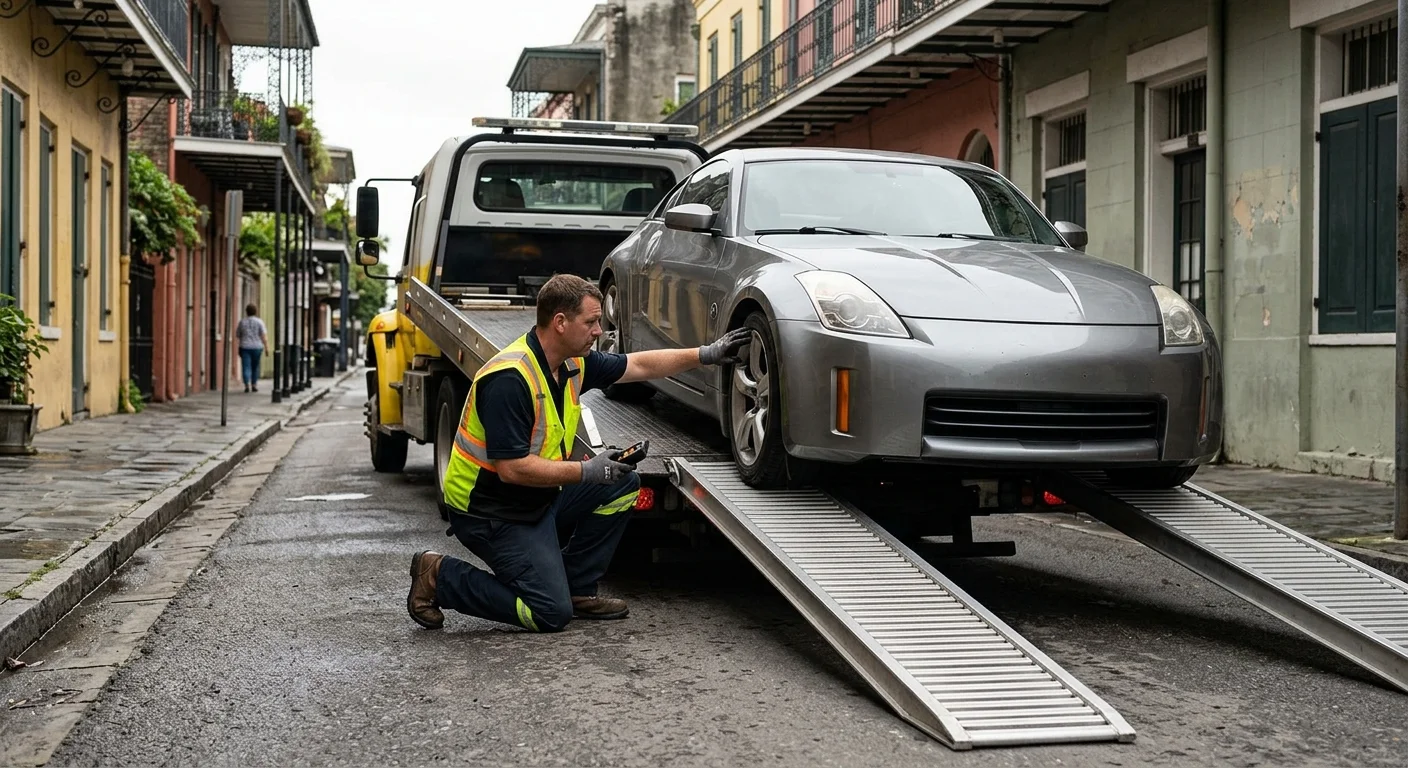
Splitter and spoiler clearance decide the load. Ask for a flatbed. Garage jobs are in tow a car from a New Orleans parking garage. We do not invent ride-height millimeters.
Ground clearance changes the loading angle
Ground clearance is only part of the loading problem. The operator also looks at the car’s wheelbase and overhangs. A long front splitter may approach the ramp before the front tires do. Rear diffusers, exhaust parts, side skirts, and underbody panels can create other contact points.
The street changes the geometry too. A flat surface offers a different approach than a steep driveway. Curbs, drainage slopes, uneven pavement, and street crowns can also affect the angle. That’s why a fixed clearance number wouldn’t answer whether a specific car can load without contact.
Flatbed towing for a low-clearance car still requires a planned transition. The operator evaluates how the tires will move from the street to the loading surface. Extended ramps or other loading aids may be considered when appropriate. The exact setup depends on the car, the loading area, and the operator’s equipment.
Our guide to flatbed towing explains the service in more detail. A flatbed doesn’t automatically make every loading plan suitable. The operator still needs to inspect the approach and identify vulnerable bodywork.
Don’t drive the car onto unfamiliar towing equipment yourself. Avoid standing between the car and the truck during loading. Show the operator any model-specific towing instructions before work begins. The owner’s manual and vehicle manufacturer remain the authorities for that vehicle.
Wheel condition and drivetrain still matter
A low body isn’t the operator’s only concern. The car’s wheels must also be assessed before it moves. A locked wheel, damaged suspension part, flat tire, or steering problem can change the loading plan.
Tell the operator whether the car rolls, steers, and enters neutral. Mention any warning messages or unusual wheel positions. Don’t force an electronic shifter or release a brake against the manufacturer’s instructions. A disabled system may require a model-specific procedure.
Drivetrain layout also matters. Front-wheel drive, rear-wheel drive, all-wheel drive, and four-wheel drive vehicles don’t all have identical towing instructions. Some manufacturers restrict which wheels may roll during transport. Others specify a transport setting, approved attachment point, or loading sequence.
Electric vehicles require the same model-specific care. “Tow mode” and “transport mode” aren’t interchangeable labels across every brand. Our article on how Teslas can be towed shows why the manual matters before moving an electric car.
The operator also needs to know whether a wheel can hold a strap normally. Aftermarket wheels, brake components, and damaged tires may affect where loading equipment can sit. Don’t assume a standard attachment point is clear because it worked on another car.
Towing a lowered car starts with accurate information. Ground clearance can be managed only after the operator understands what can roll and what must remain still.
What to report about modifications
Factory specifications don’t tell the full story after a car has been modified. Tell the operator about every change affecting ride height, body shape, steering, wheels, or suspension.
That includes coilovers, lowering springs, air suspension, custom splitters, side skirts, diffusers, and exhaust work. Mention wheel spacers, oversized brakes, unusual tire sizes, and widened body panels. Removable track equipment should also be identified before loading begins.
If the car has adjustable suspension, explain its current setting. Don’t raise, lower, or cycle that system unless the manufacturer’s instructions permit it. A disabled car may not respond normally, even when the controls still light up.
Photos can help the operator understand the job before equipment is positioned. Capture the front overhang, rear bumper, both sides, and each affected wheel. Include the driveway, garage opening, nearby curb, and space around the car. A photo taken at pavement level can show details hidden from a standing view.
Share the year, make, model, trim, and drivetrain. Also mention whether the car has its factory tow eye or another manufacturer-specified tool. Don’t describe an aftermarket attachment point as approved unless its maker says so.
Classic cars bring different questions about steering locks, fragile trim, and nonstandard modifications. Our classic-car towing guide for New Orleans covers those vehicle-specific concerns. The loading decision still belongs to the operator, guided by the vehicle manufacturer’s instructions.
Tight garages and Uptown streets add constraints
A loading plan needs enough room for both the car and towing equipment. That can be difficult inside a downtown garage or along an Uptown curb.
In a garage, report the posted height limit and the vehicle’s exact level. Note sharp turns, ramps, columns, speed bumps, access gates, and ceiling fixtures. Tell the operator whether the car is facing inward or outward. A car trapped around a corner presents a different problem than one near the entrance.
Building management may control access to loading areas or service doors. Confirm those rules before the operator starts positioning equipment. Don’t assume a garage entrance is the only usable path. Management can identify which access points are authorized.
Uptown streets create another set of constraints. Blocks near Magazine Street, Prytania Street, and St. Charles Avenue can have cars parked along both curbs. Street crowns, narrow driveways, and limited turning space may affect the loading angle. Mention streetcar tracks, medians, and temporary restrictions when they’re near the vehicle.
Festival traffic, construction, and incidents can also change street access. Check 511 Louisiana for current road conditions and closures before a street pickup. That information helps describe the location, but it doesn’t replace the operator’s site assessment.
Give the exact side of the street, nearest cross street, and garage level. Mention whether another parked car blocks the approach. Clear location details help the operator decide what setup can be evaluated at the scene.
What to confirm before loading starts
Pause before the car moves. Make sure the operator has inspected the vehicle, the loading path, and the surrounding space. Point out any part that already sits close to the pavement.
Confirm that the operator knows:
- The vehicle’s year, make, model, trim, and drivetrain
- Whether each wheel rolls and holds air
- Whether steering, brakes, and neutral work normally
- Which suspension and body parts were modified
- What the owner’s manual says about towing
- Whether keys or a manufacturer-specified tool are available
- Which bumper, splitter, diffuser, or exhaust parts sit lowest
- Whether the garage or property has access restrictions
Ask the operator to explain the proposed loading direction and attachment areas. If that plan conflicts with the owner’s manual, stop and check the manufacturer’s instructions. Don’t approve contact with a part the manufacturer excludes.
Photograph the car before loading. Capture existing wheel, bumper, rocker panel, and underbody damage you can see without crawling beneath it. Keep clear of the loading path while the operator works.
Owners of performance, exotic, and collector vehicles can also review our exotic and classic vehicle towing service. Quick Tow New Orleans doesn’t own towing equipment or perform the physical work. We match callers with independent, licensed local operators who select their own loading methods.
The right questions matter more than a universal equipment rule. Vehicle condition, manufacturer guidance, and the pickup location should shape the final plan.
When to call us
Call when a lowered, exotic, classic, or performance car needs a licensed towing professional to assess its loading needs. The line takes calls 24/7. Call (504) 474-5530. We match you with a licensed local operator who quotes before the truck rolls.