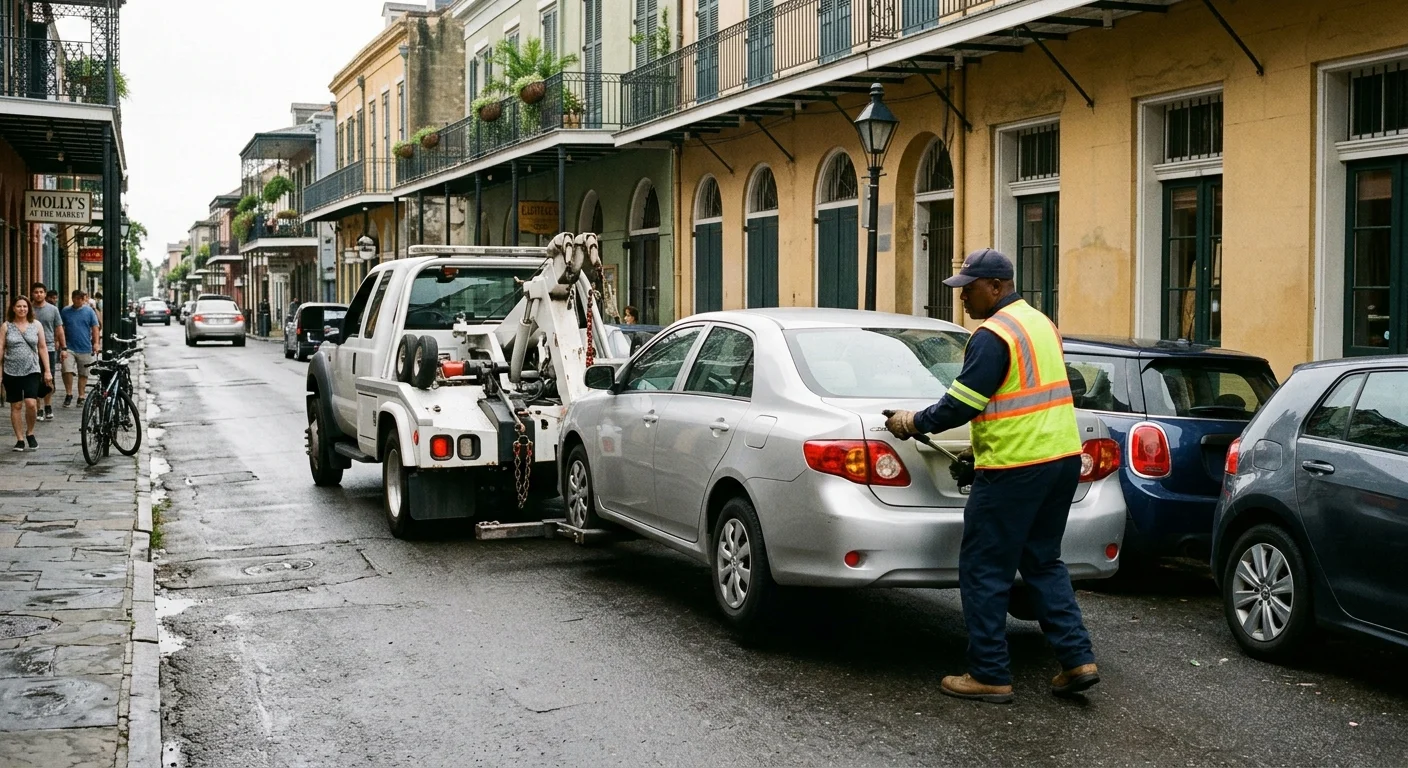
Parallel-parked geometry comes first: room at one end, axle choice, and whether the maker allows that load. See wheel-lift towing and flatbed vs wheel-lift. We do not promise a no-scratch result. Mapped SERP results for this query mixed in unrelated operator pages, so this article stays on the parking geometry.
Street position changes the operator’s approach
Parallel parking doesn’t automatically rule out a wheel-lift. It changes how the operator reaches the car and which end is accessible.
A wheel-lift raises one axle while the other axle remains on the road. That means the operator needs a workable path to the chosen wheels. A car with open space behind it presents a different job from one boxed tightly between two vehicles. The curb, traffic direction, and nearby intersections also affect positioning.
The operator may approach the front or rear of the car. That decision isn’t based on convenience alone. It also depends on drivetrain, wheel condition, steering position, and the manufacturer’s instructions.
A car parked close to the curb may still be accessible. The operator will inspect the wheel angle and available clearance. If the steering is locked sharply toward the curb, the setup may require extra equipment. A car that won’t shift into neutral creates another constraint.
The truck also needs space to line up. Wheel-lift equipment can’t solve every blocked angle. An adjacent driveway or open curb section may help, but nobody should assume it provides enough room until the operator sees the scene.
Our wheel-lift towing service connects drivers with licensed local operators who assess these details. Quick Tow New Orleans doesn’t own trucks or perform the tow. The matched operator chooses the equipment and completes the work.
Drivetrain and wheel condition still decide the setup
Parking position is only part of the answer. The vehicle itself may determine whether a wheel-lift is appropriate.
Front-wheel-drive, rear-wheel-drive, all-wheel-drive, and four-wheel-drive vehicles don’t share one towing procedure. Some models permit one axle to roll under defined conditions. Others require all wheels off the road. An electric or hybrid vehicle may also have a model-specific transport setting.
Check the towing section of the owner’s manual. Use the instructions for the exact model, year, and drivetrain. A general rule from another vehicle isn’t enough. If the manual isn’t in the glove box, the manufacturer may provide a digital copy.
Wheel condition matters too. A locked brake, damaged suspension, bent wheel, or collision-damaged axle can change the plan. The same applies when a tire is missing or the car can’t shift into neutral. Tell the operator about those problems before equipment is selected.
Wheel dollies may keep the second axle off the pavement while a wheel-lift supports the first. That setup depends on the vehicle and available street space. A flatbed tow may be chosen when the car must travel with every wheel raised.
Low bumpers, splitters, and modified suspension need attention as well. Our guide to towing a low-clearance car explains why loading angle matters. For a broader equipment overview, read flatbed versus wheel-lift towing.
The owner’s manual and the operator’s inspection should settle the setup. Parallel parking alone can’t.
Nearby cars can limit working room
The cars ahead and behind affect more than bumper clearance. They can restrict the tow truck’s approach, the wheel-lift’s alignment, and the path used to remove the vehicle.
A small visible gap may not be enough working room. The operator needs to account for the wheel-lift assembly and the movement required during hookup. The towed car’s wheels may also be turned toward the curb or another vehicle.
Don’t try to create space by pushing either parked car. Don’t release a parking brake or roll the disabled car unless the operator directs the process. A slight grade can turn an improvised adjustment into a larger problem.
If another vehicle belongs to a neighbor or passenger, moving it before the tow may open the approach. That only helps when its owner can move it lawfully and without blocking traffic. The operator still needs to inspect the resulting space.
Photos can make the first conversation more useful. Take a wide image showing the entire block and both neighboring cars. Then capture the front wheels, rear wheels, curb gap, and visible damage. Photos shouldn’t replace an on-site assessment, but they can reveal an obvious access problem.
Mention objects that a wide photo might miss. Common examples include curb extensions, planters, construction barriers, low branches, gates, and parked delivery vehicles. A narrow entrance leading to the street can matter too.
A competent operator won’t select equipment from the words “parallel parked” alone. The full space around the car determines whether the proposed approach is workable.
Narrow New Orleans streets add another constraint
Wheel-lift towing on a narrow street is partly an access problem. New Orleans blocks can change sharply from one neighborhood to the next.
In the French Quarter, one-way blocks, curbside loading, and closely spaced parked cars can leave limited positioning room. The operator needs the exact block, not only the neighborhood name. Bourbon Street and a quieter residential block don’t present the same access pattern.
Bywater streets can combine curb parking with driveways, corner buildings, and vehicles parked near intersections. A car may look reachable from one direction but not the other. Report the direction it faces and whether the open space is ahead or behind.
Uptown brings another mix. A car along Magazine Street may sit near storefront loading activity. A vehicle near the St. Charles Avenue corridor may be close to streetcar tracks or a neutral ground. A residential side street may have a different curb line and more tree cover.
These details don’t prove that one truck type will fit. Wheel-lift trucks and flatbeds come in different dimensions. The operator must compare the equipment with the actual street.
Give the nearest cross street when you call. Mention a one-way approach, temporary barricade, active construction, or blocked travel lane. If the route involves a major highway, 511 Louisiana provides current incident and closure information. It won’t show whether a curb gap is open.
Weather can also change the scene before the tow begins. If water covers the street, don’t treat it as an ordinary parking-space problem. Report the water and location clearly so the operator can evaluate the conditions.
What to report before the operator arrives
A clear description helps the matched operator bring an appropriate setup. Start with the car’s exact location, including its nearest cross street and curb side.
Provide the year, make, model, and trim when known. State whether it’s front-wheel drive, rear-wheel drive, all-wheel drive, or four-wheel drive. If you’re unsure, say so. Don’t guess from the badge or body style.
Describe what the car can still do. Can it start, steer, roll, and shift into neutral? Are the keys available? Is the parking brake stuck? Mention any warning message that affects towing or transport mode.
Report every damaged wheel or tire. Include visible suspension damage, a low front splitter, aftermarket bodywork, or reduced ride height. Say whether the car was in a collision, struck a curb, or stopped because of a mechanical problem.
Explain the parking space itself. Is the car close to both neighboring bumpers? Is one end open? Are its front wheels turned into the curb? Is it beside a driveway, loading zone, gate, or construction barrier?
A photo from each end can show the available approach. A wider street view helps establish traffic direction and nearby obstacles. Keep the images focused on the vehicle and access area.
Quick Tow New Orleans uses those details to match you with an independent, licensed local operator. The operator makes the final wheel-lift, dolly, or flatbed decision after reviewing the vehicle and street.
When to call us
Call when a parallel-parked vehicle won’t move or its drivetrain, wheel damage, or street position makes the towing setup uncertain. The line takes calls 24/7. Call (504) 474-5530. We match you with a licensed local operator who quotes before the truck rolls.