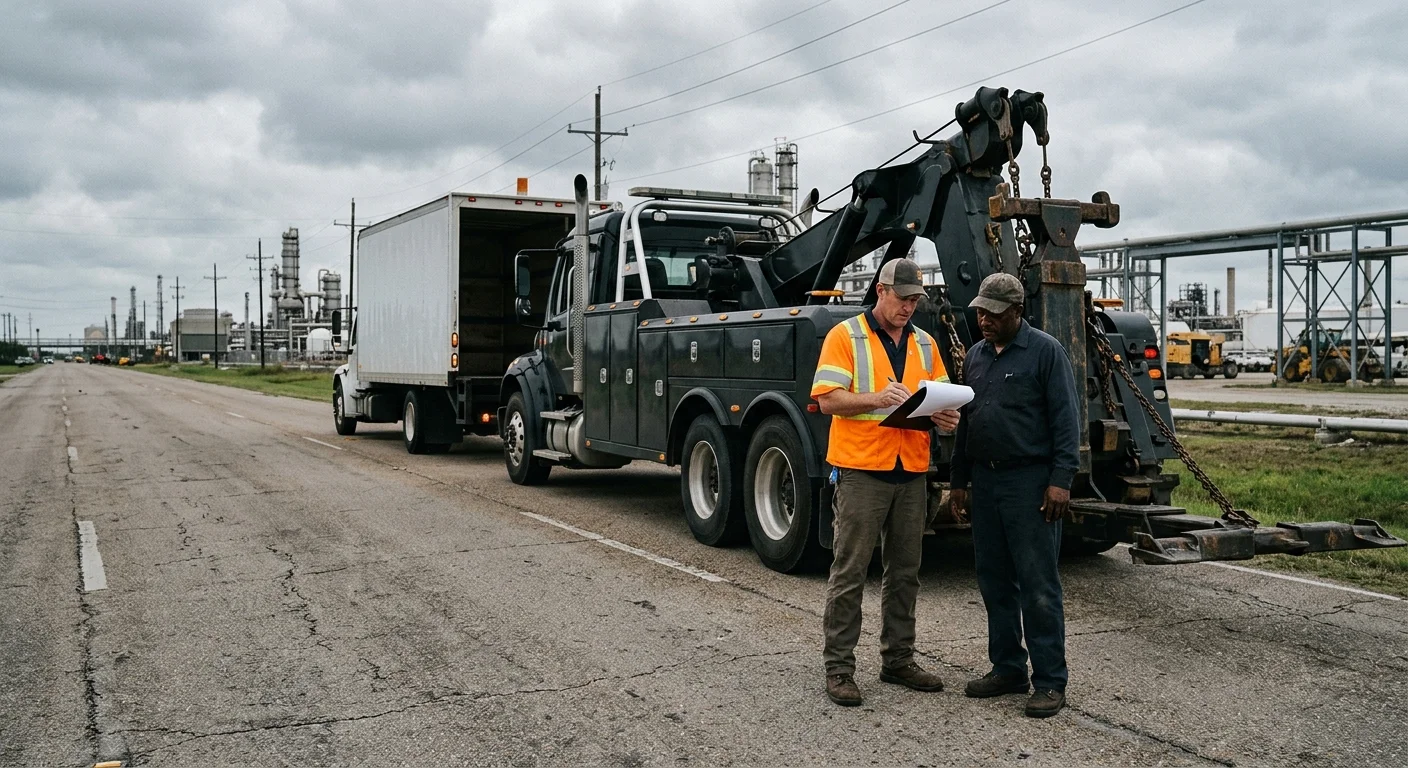
LPSC dollar figures on this page are nonconsensual maxima, not Quick Tow prices. Keep $95 out of heavy-duty. Ask GVWR, loaded or empty, and destination. See heavy-duty towing and box truck breakdown. We do not publish a fleet count or an arrival clock.
Louisiana doesn’t publish one regulated per-mile rate for every heavy-duty job. The current state schedule covers non-consensual towing through hourly maximums, minimum billing periods, storage charges, surcharges, and documented recovery add-ons. A customer-requested tow follows the independent operator’s own pricing instead.
Start with the vehicle and recovery type
Start with the vehicle’s gross vehicle weight rating, or GVWR. Louisiana’s regulated schedule defines Heavy Duty as 26,001 pounds and above. Medium Duty covers 10,001 through 26,000 pounds.
That distinction matters because appearance can mislead. A box truck, motorhome, tractor, trailer, or commercial service vehicle may need different equipment. The operator needs the actual vehicle specifications before selecting a towing unit.
Share these details when requesting heavy-duty towing:
- The power unit’s year, make, model, and GVWR
- Whether a trailer is attached
- Whether the vehicle is loaded
- The cargo type, if any
- The vehicle’s position and visible damage
- Whether every wheel can roll
- The pickup point and intended destination
Next, describe what happened. A disabled truck sitting upright on firm pavement presents a different job from a rollover, ditch recovery, cargo shift, or water recovery. The second situation may involve recovery work before transport can begin.
Location also changes the plan. A truck stopped along I-10 or I-610 presents different access conditions than one on US-90B. A vehicle on the Lake Pontchartrain Causeway falls within a patrolled bridge system. A run between New Orleans and the North Shore also isn’t equivalent to a short move within Orleans Parish.
Quick Tow New Orleans doesn’t perform the physical work. We match callers with independent, licensed local operators. The operator determines the equipment, billing method, and final charges.
Why a per-mile question may be incomplete
No single heavy-duty per-mile maximum appears in the approved Louisiana schedule. For non-consensual work, the Louisiana Public Service Commission uses time-based rates instead.
Under the LPSC schedule effective April 1, 2026, Heavy Duty towing has a maximum of $430.50 per hour with a one-hour minimum. Heavy Duty transit time has a $430.50 hourly maximum. Standard recovery is capped at $525.50 per hour, while simple water recovery is capped at $556.50 per hour.
Towing time after the minimum is computed in half-hour increments. Recovery and transit time are also computed in half-hour increments. Those are maximum regulated charges for non-consensual work, not Quick Tow prices or universal quotes.
A fuel surcharge may also apply to towing, recovery, transit, and qualifying extra truck charges. It can’t be applied to storage or other fees. The percentage depends on the current Gulf Coast diesel band identified in the LPSC schedule.
Consensual towing works differently. When a vehicle owner directly requests and approves a tow, the LPSC’s non-consensual maximums don’t set that operator’s price. Ask the operator whether the quote uses hours, mileage, a minimum charge, or several billing components.
If a per-mile figure is offered, ask what it includes. Confirm whether hookup, transit, recovery, tolls, storage, and special equipment appear separately. For longer transport, our guide to long-distance towing prices in New Orleans explains other questions to settle before agreeing to the move.
How recovery work can differ from transport
Transport begins once a vehicle is ready to move. Recovery is the work required to reach that condition. The difference can reshape the bill.
A truck standing upright on pavement may need towing without extensive recovery. A vehicle off the roadway may need controlled pulling, repositioning, debris handling, or specialized equipment. Crash scenes can also require work before the towing unit can connect safely. Our accident recovery and winch-out guide explains this service distinction.
The LPSC separates towing, transit, and actual recovery time on non-consensual invoices. Standard recovery doesn’t automatically include towing time, standby, or transit. Each applicable charge should appear separately.
Complicated recovery has more rules. An extra truck or a truck and trailer used for cargo, oversized debris, or specialized equipment may be billed at up to $192 per hour. Photographs and an explanation are required. A rotator may add up to $299 per hour above the standard recovery rate, with a two-hour minimum and photo or video documentation.
Specialized rented or subcontracted equipment may be billed at the invoice amount plus 10 percent. Company-provided specialized services may use documented current market value plus 10 percent. Unsecured hazardous-material cargo can raise certain towing, recovery, laborer, and supervisor rates by 50 percent.
Ordinary required truck equipment can’t become a separate equipment charge. The schedule identifies items such as chains, hooks, cables, blocks, brooms, warning devices, and fire extinguishers as ordinary equipment.
These regulated figures apply only to qualifying non-consensual work. For a consensual recovery, request the independent operator’s billing terms before authorizing service.
What documentation to request before payment
A clear invoice should let you follow the job from dispatch through release. For a regulated non-consensual tow, Louisiana requires an itemized invoice. You can request a copy without paying first.
Check for the dispatch time and the time the vehicle was unhooked. Towing, recovery, transit, standby, storage, fuel surcharge, and other charges should be separated. A single unexplained total makes comparison difficult.
For complicated recovery, match each special charge to its support. An extra truck used for cargo or oversized debris requires photographs and written justification. A rotator charge requires photo or video proof. Rented equipment should have the underlying invoice attached. Other specialized work needs documentation showing its basis.
Before approving a consensual tow, ask the operator to confirm:
- The vehicle’s duty class
- The pricing method and any minimum
- When billed time begins and ends
- Whether transit is separate
- Whether recovery work is anticipated
- Which equipment could create added charges
- The storage location and daily billing basis
- Any fuel surcharge or card-processing charge
- The destination and release procedure
Tow companies handling regulated non-consensual work must accept credit cards. A passed-through processing charge must appear as a separate line item.
Keep photographs of the vehicle’s position and condition when it’s safe to take them. Save the authorization, invoice, payment receipt, and supporting recovery documents. If access to the truck, cargo, or destination becomes disputed, read our guide to Louisiana tow laws when an operator says no before deciding what to do next.
Where to verify a regulated charge
First, identify who arranged the tow. That determines which pricing rules may apply.
The LPSC schedule governs non-consensual towing and recovery across Louisiana. That category is broader than many drivers expect. Even when a vehicle owner asks a police officer to arrange the tow, the LPSC order treats the resulting job as non-consensual.
Check the schedule’s effective date before comparing charges. LPSC staff adjusts the rates for the Producer Price Index each April 1, or the next business day. The change becomes effective when posted. A dollar figure copied from an older invoice or article may therefore be stale.
For Jefferson Parish, no separate parish dollar schedule has been confirmed for publication. Use the current LPSC schedule when reviewing a qualifying non-consensual tow. Don’t treat those maximums as prices for a customer-arranged service.
A City of New Orleans impound is another category. City charges belong to the City, not Quick Tow or a matched operator. The City’s published storage information conflicts with another recorded schedule, so a current City storage rate couldn’t be confirmed for this page. Check the City’s vehicle-release page directly before paying.
Every regulated non-consensual invoice must include the LPSC complaint address and website. A driver doesn’t need to pay the invoice before having standing to complain. If a written complaint later results in a finding of excessive charges, storage stops accruing as of the complaint date. The Commission may order a refund of up to 200 percent of an overcharge.
When to call us
A loaded commercial vehicle, damaged truck, separated trailer, or off-road recovery needs a licensed towing professional. The line takes calls 24/7. Call (504) 474-5530. We match you with a licensed local operator who quotes before the truck rolls.