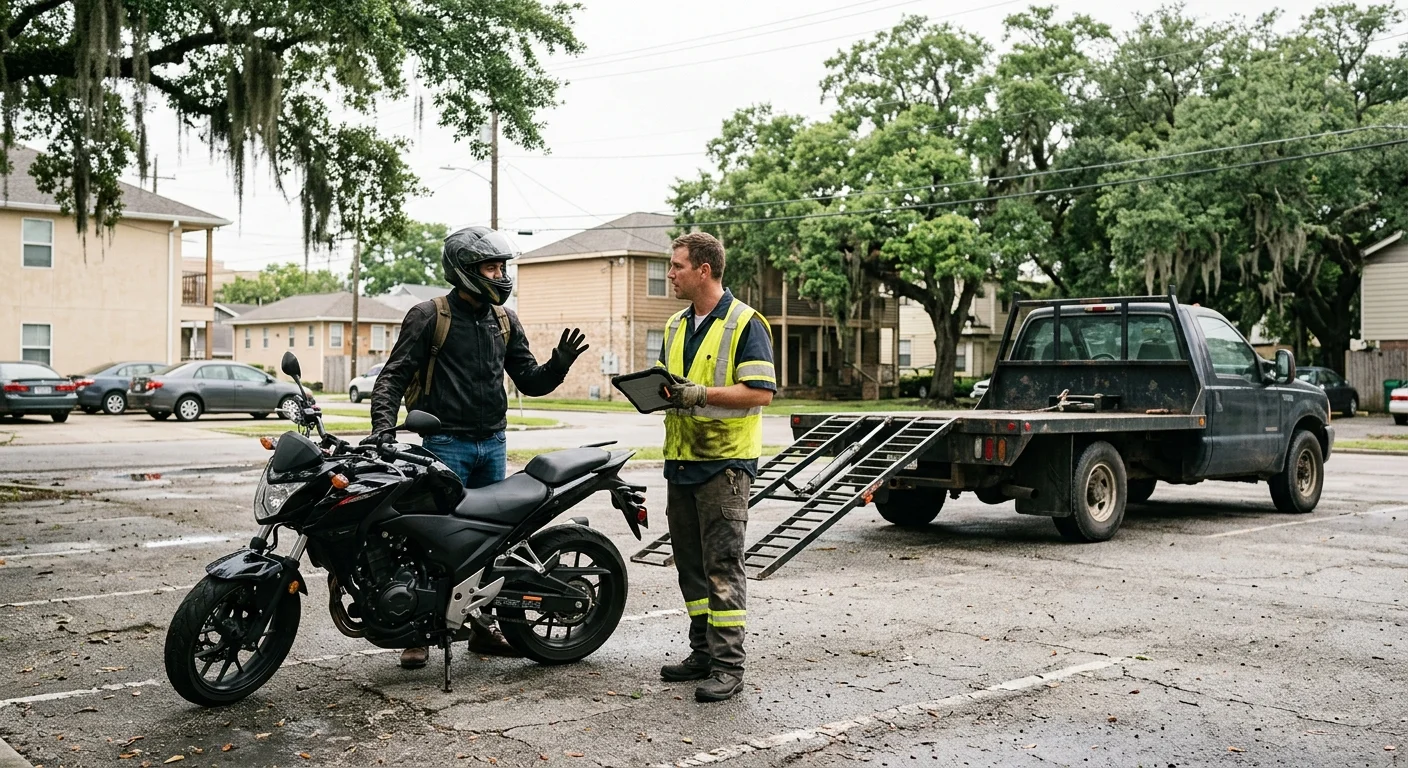
Flood, a dead battery, and a bike that will not go into neutral are the three facts. Loading method is in how motorcycle towing works. A 12-volt jump comparison only belongs if the bike has a jumpable battery like a car; see jump-start or tow only for that overlap.
Start with what the motorcycle is doing
You don’t need to diagnose the motorcycle before calling. You do need to describe what happens when you try to start it.
Tell the operator whether the instrument panel lights up. Report whether the engine turns, clicks, or stays silent. Mention unusual sounds, visible damage, warning lights, or a strong odor. These observations help the operator understand the request without turning you into a roadside mechanic.
Also explain what happened before the bike stopped working. It may have been parked normally and then refused to start. It may have stalled while moving. The problem may have followed a fall, collision, deep water, or flat tire. Those are different service calls, even when the final symptom is the same.
Don’t take apart electrical parts or attempt roadside testing based on guesses. Push-starting instructions also vary by motorcycle. Consult the owner’s materials when a model-specific step matters. If those materials warn against a procedure, don’t ask an operator to improvise it.
The most useful description separates what you observed from what you suspect. “The panel is dark” gives the operator something concrete. “The battery is definitely bad” may send the request in the wrong direction if that diagnosis hasn’t been confirmed.
Quick Tow New Orleans doesn’t repair or tow motorcycles. We take the call and match drivers with independent, licensed local operators. Your description helps us look for an operator whose available service fits the situation.
When roadside help may fit the problem
Roadside assistance may fit when the motorcycle is intact and the problem appears limited to a service available at its current location. That could mean asking whether an operator offers battery support or emergency fuel delivery for motorcycles.
Don’t assume every roadside service handles every bike. Motorcycle batteries, access points, alarms, and manufacturer instructions differ. Give the year, make, and model, then ask the matched operator to confirm whether the requested service is appropriate. Keep the owner’s manual available if it contains model-specific guidance.
Running out of fuel also requires a clear description. Tell the operator what the gauge showed and whether the engine stopped while riding. If fuel is delivered but the motorcycle still won’t run, the request may change from roadside help to transport.
Louisiana’s DOTD Motorist Assistance Patrol provides minor free help on covered highway segments. Its listed services include jump-starts and about a gallon of emergency fuel. MAP is a fixed-schedule patrol, not a call-out service. If a unit isn’t already present, a stranded motorist contacts local law enforcement, or 911 during an emergency. MAP can clear a disabled vehicle from a travel lane, but it doesn’t transport vehicles to repair shops.
Roadside help is a service attempt, not a diagnosis. If the available service doesn’t match the motorcycle or doesn’t restore operation, towing becomes the next practical request.
When the bike may need transport
Request motorcycle towing when the motorcycle can’t be made ready where it sits. Transport may also be appropriate after a collision, fall, flood exposure, wheel problem, steering problem, or another condition that makes riding questionable.
You can also choose a tow without first trying roadside service. That may be the clearer option when you already want a repair shop to inspect the bike. Tell the operator whether the destination is a dealership, motorcycle shop, home, or another permitted location.
A motorcycle call needs different information from a standard car tow. The operator should know whether the bike stands upright, rolls, steers, and has an accessible key. Report a locked wheel, flat tire, damaged fork, loose bodywork, or leaking fluid. Don’t move damaged parts merely to make loading appear easier.
The matched operator decides what transport setup fits the motorcycle and its condition. Our guide to how motorcycle towing works explains the service process without asking you to load or secure the bike yourself.
Confirm the destination can receive the motorcycle. A closed gate, restricted parking area, or inaccessible service entrance can complicate delivery. If someone else will meet the operator, share that arrangement before transport begins.
Quick Tow is the matching service, not the towing company. The independent operator performs the transport, sets the terms, and receives payment directly.
Location and wheel condition change the request
Start with the motorcycle’s exact location. “New Orleans” isn’t enough. A surface parking space near Carrollton Avenue presents a different access question from a garage in the French Quarter or a shoulder along I-10.
Give the street, nearest cross street, travel direction, and a recognizable entrance. For a parking garage, report the level and posted clearance. For an apartment or business lot, mention gates, access codes, loading areas, and parking restrictions. Don’t share a code publicly. Give it directly to the matched operator when needed.
On I-10, I-610, or US-90B, report the direction of travel and the nearest exit. Check Louisiana 511 for current incidents, closures, construction, and traffic conditions. If the bike is on the Lake Pontchartrain Causeway, use the posted Causeway Police contact procedure. The bridge is patrolled around the clock, and the Causeway authority publishes its breakdown and fog procedures.
Metro geography also changes the conversation. Say whether the motorcycle is in Orleans Parish, Jefferson Parish, St. Bernard Parish, or on the North Shore. A location in Metairie or Kenner shouldn’t be described only as New Orleans. The same applies to Gretna, Terrytown, Slidell, and Mandeville.
Wheel condition matters just as much. Tell the operator whether each wheel rolls and whether the handlebars turn. Report a flat tire, damaged rim, locked steering, broken suspension, or contact between a wheel and bodywork. If you can’t safely inspect something, say that it remains unknown. Clear uncertainty is more useful than a confident guess.
What to report before an operator is matched
A short, factual call keeps the request focused. Have these details ready:
- The motorcycle’s year, make, and model
- Its exact location and travel direction
- The nearest exit, cross street, or property entrance
- What happens when you attempt to start it
- Any warning lights, unusual sounds, odors, or visible leaks
- Whether the motorcycle is upright
- Whether both wheels roll and the handlebars turn
- Any flat tire, crash, fall, flood, or steering damage
- Whether the key is present
- The requested destination, if transport is needed
- Garage clearance, gates, access limits, or parking restrictions
- Any luggage, loose accessories, or modifications affecting access
Use the owner’s materials to confirm details you don’t know. A photo of the motorcycle, wheel condition, instrument area, and surrounding access may help the operator assess the request. Don’t operate controls or move damaged parts solely to create a better photo.
Say what outcome you want. Ask for roadside help if you want a specific available service attempted where the bike sits. Ask for towing if the goal is getting the motorcycle to a shop or another destination.
Before accepting service, confirm the scope and payment terms with the independent operator. Quick Tow doesn’t set operator prices. If you’re planning transport, what changes motorcycle towing rates explains the job details that can affect the operator’s charge without presenting a universal price.
Finally, provide a callback number and say whether you’ll remain with the motorcycle. If another person has the key or will meet the operator, disclose that arrangement during the call.
When to call us
Call when the motorcycle remains disabled, needs professional transport, or requires roadside service from a licensed local operator. Our line takes calls 24/7, and Quick Tow New Orleans matches callers with independent operators rather than performing the work. Call (504) 474-5530. We match you with a licensed local operator who quotes before the truck rolls.