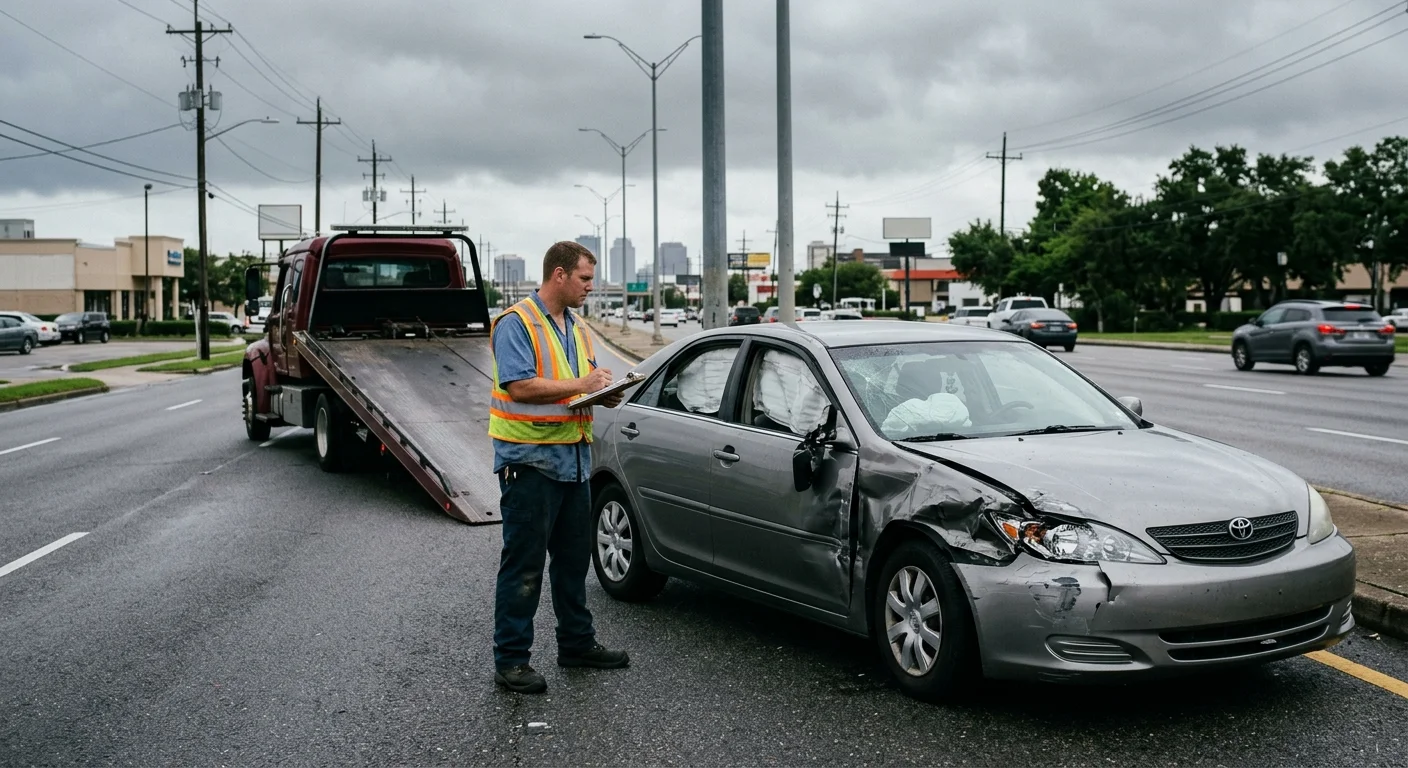
The bags are hanging out of the steering wheel and the car is still in a live lane on I-10 near the High Rise. That view does not tell you whether the car can leave. A licensed operator can often load a crash-damaged car after the airbags deploy, once they see how it sits, what still rolls, and who is running the scene.
Start with the car’s position and visible damage
Start with where the car is, not with the fabric in the cabin. A sedan stopped in a travel lane on I-10 through New Orleans East is a different job from the same car sitting in a Kenner parking lot. A Westbank Expressway shoulder, a French Quarter curb, and a flooded Carrollton underpass all change how an operator can approach the vehicle.
Look at what you can see from a safe spot. Note which wheels still sit on pavement. Note whether the car is against a barrier, in water, or blocking a lane. Note whether police, fire, or DOTD Motorist Assistance Patrol are already there. MAP can move a disabled vehicle out of a travel lane on the stretches it patrols. It does not tow the car to a shop.
If anyone is hurt, call 911. University Medical Center New Orleans at 2000 Canal Street is the region’s confirmed Level I trauma center. That is medical routing, not a towing decision. If the car is on the Lake Pontchartrain Causeway, call Causeway Police at *27 or (504) 835-3116. Causeway Police run that bridge. A referral line does not.
Stay out of floodwater. The National Weather Service’s Turn Around Don’t Drown® guidance is plain: 12 inches of rushing water can carry away most cars, and 2 feet can carry SUVs and trucks. Do not walk into that water to check the car.
From dry ground, the useful report is short. Parish, road, direction, lane or lot, and the obvious damage. Deployed airbags belong on that list. So do a crumpled corner, a wheel tucked under the fender, fluid on the pavement, and whether the car still sits on all four tires. That is what the matched operator uses to decide the truck, not a guess about what happened inside the dash.
Deployed airbags don’t describe the whole recovery
Airbags mark a hard hit. They do not describe the recovery. Two cars can show the same white bags and need two different loads. One still rolls onto a bed. The other has a locked steering column, a folded control arm, or a wheel that will not turn.
The bags also do not answer the insurance question people ask first. In Louisiana, a total-loss vehicle is one with damage equal to 75% or more of market value per the current NADA Handbook, under R.S. 32:702. A salvage title is what OMV issues after an insurance settlement declares that total loss. Deployed airbags alone do not make that call. The insurer weighs the whole repair against the car’s value. Cosmetic hail damage at that same 75% threshold is a branded hail title, not a salvage title. That exception does not apply to a crash.
A shop can replace an airbag system. That work is not a tow. Do not pull, cut, fold, or reset the bags. Do not treat the cabin as a DIY repair bay. The operator who loads the car is there to move it. They are not there to rebuild the restraint system.
Louisiana does not have a confirmed statute, in this site’s claims file, that makes driving after airbag deployment illegal by itself. That is not permission to drive the car. The bags fired because the crash was violent enough to trip the system. Steering, brakes, electrics, and the next set of restraints may be compromised. Have the car inspected before anyone treats it as a daily driver. Until then, plan on a tow.
If an officer is already arranging the wrecker, the tow is non-consensual under the Louisiana Public Service Commission’s rules even when you asked the officer to call. Those jobs are capped by the LPSC schedule effective April 1, 2026. A tow you request on your own, without that police arrangement, is a different product. Do not mix the two.
The right comparison on the scene is not “bags or no bags.” It is whether this is a standard hook or a recovery. That split is laid out in accident recovery or a standard tow. Deployed airbags push many jobs toward recovery because the rest of the car often will not roll, steer, or sit level.
Wheel and steering damage change the request
The driver’s airbag comes out of the steering wheel. After that, assume the wheel and column need a look before anyone talks about rolling the car. A wheel-lift needs tires that can turn and a steering path that will follow the truck. A locked column, a bent tie rod, or a rim folded under the fender ends that plan.
Tell the operator what the wheels are doing. A car that still sits square can be a cleaner load. A car with a blown corner on I-10 at the High Rise, or one that hopped a curb on Canal, may need winching onto a bed. That is accident recovery, not a parking-lot hookup.
Flatbed towing is the usual request when the car cannot roll safely. The whole vehicle rides on the deck. Nothing has to steer down the road. That matters when the airbags have already torn through the wheel, the dash, or a side curtain and you cannot tell what else broke.
Do not try to free a locked wheel, force the shifter, or drag the car onto a shoulder yourself. If the car will not go into neutral, say so. If a tire is off the rim, say so. If the car is sitting on its oil pan in a Gentilly median, say so. Those details change the truck that shows up.
Parish geography changes the run after the load, not the need for the right truck. A Metairie crash and a Slidell crash can look identical in the cabin and still sit on different road networks, with different wrecker access and a longer or shorter trip to the shop you name. Name the parish and the road. Do not assume metro New Orleans is one scene.
A crash scene and a parked damaged car are different
A live crash and a parked, already-damaged car are not the same request. On a crash scene, law enforcement controls the lane, the lighting, and often the wrecker. Quick Tow New Orleans matches you with a licensed local operator. It does not run the scene and it cannot override a public authority.
If the car is still in a travel lane, stay out of traffic. Louisiana’s Move Over law, R.S. 32:125, requires other drivers on a multi-lane highway to change lanes away from a parked vehicle using authorized flashing warning lights when they can do so safely, or to slow to a reasonably safe speed. A violation is a fine of up to $200. That rule is for the traffic around the scene. It is not a towing method.
Check 511la.org for the incident if you are trying to describe the backup to someone who is not there. It will not load the car.
A parked car with deployed airbags is quieter and still not a DIY move. That is the car that made it to a lot behind a Mid-City shop, a driveway in Terrytown, or a hotel garage near the Quarter after the crash. The operator still has to see whether it rolls, leaks, or sits too low for the truck you had in mind. The difference is who is in charge. No officer is holding the lane. You can usually name the destination.
If the City of New Orleans already towed the car from a street, that is an impound, not an owner-called recovery. Call (504) 658-8100 to find it, and use the City’s Find My Towed Vehicle page. Payment is directed to 400 N. Claiborne Ave even when the car is later held elsewhere. Confirm the pickup location with the City. Jefferson Parish impound questions for unincorporated areas go through the Jefferson Parish Sheriff’s Office at (504) 363-5500. Confirm the yard and how to pay with JPSO or the agency that ordered that tow.
The Louisiana Towing and Storage Act, R.S. 32:1711, is the state’s policy frame for licensed towing and storage. It does not let a referral line pull a car off a police scene on its own clock.
Choose the destination before the car moves
Name the drop before the truck pulls away. A body shop in Metairie, a dealer on Veterans, your driveway in Algiers, or an insurer’s lot are different runs. Once the car is on the bed, changing that plan costs time and another decision at the curb.
Who gets to choose is not always you. On a police-controlled crash, the officer may send the car to a rotation wrecker’s yard. Read who chooses the tow destination after a New Orleans crash before you assume the car is going to your mechanic. If you can name a shop and the officer allows it, say the address out loud and confirm it with the operator.
Louisiana does not require comprehensive, collision, or towing coverage. Only liability is compulsory, at the 15/30/25 limits under R.S. 32:900(B)(2) and R.S. 32:861. Whether a tow bill is covered is a question for your own policy, not for state law. Call your insurer for that part. Do not wait on a coverage guess to get a disabled car out of a live lane.
If the car may be a total loss, the destination still matters. A shop can write an estimate. A storage yard starts a clock under the Towing and Storage Act once the car is in. Ask where the car is going, who is storing it, and how you pick it up. Get an itemized invoice. For a non-consensual tow, that invoice must carry the LPSC complaint address in Baton Rouge.
Keep the request specific. Parish, road, deployed airbags, wheels that do or do not roll, and the destination you want if you are allowed to name one. That is enough for a licensed operator to decide how to load a crash-damaged car.
When to call us
Call when the airbags are out and the car still has to leave a lane, a lot, or a driveway, and you need a licensed local operator to load it. The line takes calls 24/7. Call us at (504) 474-5530 and we’ll connect you with a licensed local operator.